Problem/Motivation
Many platforms and development environments use Basic Auth configured on the server to provide a Site Lock. This allows making sites available to select people via the public web without exposing the site to the public in general. For example, https://pantheon.io/docs/lock-environment/. This could be a "production" site before it goes live, or on a dev/staging site.
This server-level auth can conflict with Basic Auth in Drupal if it is set up for access to an API endpoint.
Per http://drupal.stackexchange.com/a/212800/394 and an examination of the Basic Auth provider code, what's happening is that if you use Basic Auth headers, PHP will pick them up and the Basic Auth module in core will be "triggered' to attempt authentication with those credentials. If it fails, the response will be redirected to access denied. After all, a login attempt just failed.
The frustration level this issue can cause makes it a major DX issue when the stars align, and while I marked it as a bug, you could argue it's a support request.
Proposed resolution
This issue is complicated because it could be considered a feature, not a bug. However, there is a common expectation that a "site lock" can be configured without regard for the application configuration.
One solution could be a setting that allows checking to see if the user account does not exist, and if not treat it as an anonymous request. However this can allow potential timing attacks/username enumarations #3241232: [policy] Treat username enumerations as security bugs that require Security Advisories, given that the module doesn't have any configurations, it should be a settings.php setting that specific sites which require the behaviour will have to explicitly opt in.
/**
  * Enable validation of the login username when using the basic_auth module.
  *
  * This should only be enabled if there's potentially conflict between server-level
  * basic auth prompts and the basic auth prompts provided by the module. And is there
  * to avoid false positives triggering failed login attempts and blocking the user's IP from
  * accessing the site.
  *
  * Having this enabled can potentially allow username enumeration or timing attacks, so
  * great consideration should be taken before enabling it.
  *
  * See https://www.drupal.org/project/drupal/issues/3241232 for more information.
  */
# $settings['basic_auth_3241232_sa_username_enumeration'] = TRUE;
This issue may also be potentially mitigated by the #2839210: Basic auth returns 403 when username & password supplied but not needed. issue, and would then be up to the server administrator to ensure that routes which require Drupal basic authentications are exempt from the server-level prompts, however this level of granularity isn't always possible especially if the user isn't directly running the server.
Another possibility would be supporting the Drupal site issuing Basic Auth challenges, allowing the site itself to provide the "lock UI" - but that seems a bit out of scope, and is better provided by a contrib module such as Basic Auth Global.
Remaining tasks
Decide if this is a problem that should be solved. If not solved, this becomes a documentation problem to explain what's going on and recommended workarounds.
User interface changes
N/A
API changes
N/A
Data model changes
?


 Show commands
 changes


Comments
Comment #2
wim leersI think the best and only sane solution is to not use the
basic_authmodule when you use such a feature on your hosting platform. Once we have OAuth2 in core (#2834718: New experimental module: OAuth2), that'd be realistic.That being said: couldn't we solve this by using a different realm? And perhaps the problem is that the
basic_authmodule is not validating the received realm?See http://stackoverflow.com/questions/12701085/what-is-the-realm-in-basic-a....
Comment #3
Grayside commentedGiven things like API integrations can intersect with "testing environment", it's not always avoidable. But agreed that easy oAuth will further push this to an edge case.
Realms sound like a good solution. If I understand correctly, we would execute that as follows:
applies()method. If there is not a match, Drupal Basic Auth will be skippedComment #4
wim leersThat sounds good :)
Do you perhaps have the capacity to take this on?
Comment #5
Grayside commentedI know a guy that may check into it soon. If not I might tackle it in a week or two just to learn more about realms.
Comment #6
dmouseHey! I need to test correctly this patch but my local tests don't work
Comment #7
dmouseComment #9
wim leersThis is apparently also a problem with the Shield contrib module: #2815945: Make shield work with D8 core basic_auth (1).
Comment #10
mudassar774 commentedTested with my site. this patch works for me
Comment #11
wim leersThis will need test coverage before it can go in.
Comment #13
mudassar774 commentedIt was working fine before drupal latest release 8.2.6. but now again causing problem.
Comment #14
badjava commentedI believe the patch in #6 only works if the site name is Drupal. I created a new function to generate the basic realm string since it needs to be used in the exception and the verification.
Comment #15
badjava commentedComment #17
timmillwoodNone of the patches here work
$request->headers->get('www-authenticate');returns null for me.I think a better solution would be checking (at least) the username is valid before going any further.
Comment #18
timmillwoodNote: Shield really needs the patches from #2822720: Exclude/Include Pages from Shield Protection (D8 Feature Port) and #2815945: Make shield work with D8 core basic_auth (1) then basic auth paths (such as Rest or Relaxed Web Services) need to be white-listed in shield.
Comment #20
wilco commentedJust to bring a bit of insight into those hunting down why Relaxed along with Workspace might be throwing Access Denied with Server-side Basic Auth setups, the patches in #14 must be applied for you to dig yourself out of that hole.
I also recommend, as a way to speed up your development process, use a Header add-on and place the following in two modify statements:
This should make your lives a bit easier
Comment #21
mirom commentedwww-authenticateheader is response header, not request and is populated by app, so none of previous patches will work. In shield (https://www.drupal.org/node/2822720#comment-12154615) I posted patch to whitelist all paths with _format query as I dot know if there is any other way to say that the request is rest.Comment #22
e0ipsoThe OAuth2 specification supports using Basic Auth to provide the client id and password (see https://tools.ietf.org/html/rfc6749#section-2.3.1). Simple OAuth (the candidate in #2834718: New experimental module: OAuth2) supports that feature since #2852290: Support HTTP Basic Auth for client ID and secret. Given that, I am confident that Simple OAuth is also afflicted by this issue. There's already a support request for it #2882780: Simple OAuth on a site with access protected by basic auth.
Comment #23
wim leersMarked #2618780: Basic Authentication breaks site when used with another basic auth protection as a duplicate.
Comment #24
berdirWe currently don't consider ways of figuring out if a username is registered on a site a security issue, but this would allow to differentiate between non-existing usernames and valid username with invalid password fairly easily. Especially since it would also bypass flood protection.
Also, the login service is.. a service. That can be replaced. We do that in various project to allow e-mail or username for login, hardcoding the username check would break that.
Comment #26
juampynr commentedI did some debugging and found out the following:
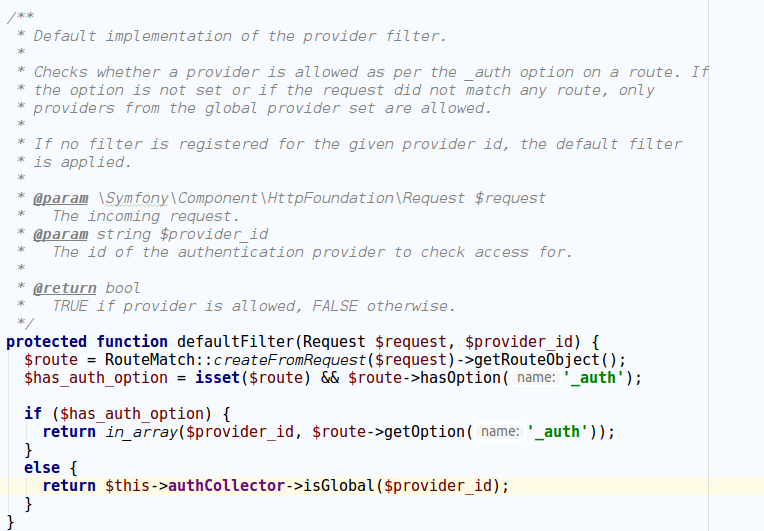
This filter denies access on routes that do not define an authentication provider unless the authentication method is global:
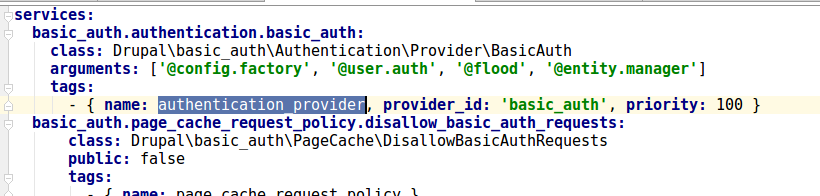
Looking at authentication providers, cookie is global:
But basic auth is not:
I think that the current setup in core is correct by filtering supported authentication methods. However, for cases where basic authentication at the web server level is needed, I have created https://www.drupal.org/project/basic_auth_global in order to allow navigation as an authenticated user.
Thoughts on this?
Comment #27
grimreaperHello,
I just ran into the same problem for a staging environment.
Thanks for the workaround with the basic_auth_global module.
Comment #29
socialnicheguru commentedFor me the patch in 17 worked
the basic_auth_global module did not work
Comment #30
br0kenCan we define
basic_auth.authentication.basic_authwithglobal: TRUE?Comment #31
wim leersI don't think we can do that — that'd mean it's always allowed. That'd be a huge change.
Comment #32
interdruper commentedIn our case, https://www.drupal.org/project/basic_auth_global works like a charm as a workaround. Gracias @juampynr
Comment #34
matt bhttps://www.drupal.org/project/basic_auth_global not working for me on pantheon with Drupal 8.6.4. I have to turn the site lock off in order for it to work.
Comment #35
goldenflower commented#17 works for me i am using Drupal 8.6.4
Comment #36
luismagr commentedHi!
#17 works for me too in 8.6.13. Thanks for the patch :)
Comment #37
socialnicheguru commented#17 worked for me too
Comment #38
g.jordan commentedCan anyone confirm if patch #17 is working with 8.6.15? I had it working on 8.5.x but after updating to 8.6.15, I'm back to the original issue of the site only showing the login page, no matter where you navigate.
Comment #39
luismagr commentedHi!
I've tested again the patch and it's still working for 8.7.0.
Comment #40
g.jordan commentedThanks!
Comment #41
e0ipsoGood!
Just a recap: this is a problem with a conflicting setup. The Basic Auth Drupal core module has the same issues. We have a patch in #17 that seems to be working for some.
Comment #42
socialnicheguru commentedIt does work for me too
Comment #43
sershevchykI use Drupal 8.7.2 for now and still have a problem with basic_auth module. I get error 403 You are not authorized to access this page. I tried to use a patch #17 but this code doesn't solve the problem.
Comment #44
Jean Mercedes commentedHello guys,
I comfirm, patch #17 is working for me.
Comment #45
bserem commentedI needed to protect some dev sites (I do not have a need for the patch on production) and #17 worked as expected.
I will move this to RTBC so that it catches someones attention, otherwise it will be stuck here forever.
Feel free to update this as required.
Comment #46
alexpott@bserem something cannot be rtbc when the tests are not passing and there is not consensus that this is the correct approach. Making something rtbc to just get attention is not the best way to move something forward. Now, for example, if I look at this issue I'm rewarding the behaviour which I don't want to do.
Comment #47
druplr commented#17 works for me on 8.7.1.
Comment #48
iuana commented#17 works for me as well. Thanks!
Comment #49
wim leersThis issue has gone unsolved for too long. Let's get it back on track.
\Drupal\basic_auth\Authentication\Provider\BasicAuthauthentication provider "global" like @juampynr explained in detail in #26 and made possible via his https://www.drupal.org/project/basic_auth_global contrib module (thanks, @juampynr!) is that it allows HTTP Basic Authentication to be used on all routes by all users simply by installing thebasic_authmodule. That's what making an authentication provider "global" means.This is very tricky to solve without negative security impact (definitely in #24, arguably also in #26/https://www.drupal.org/project/basic_auth_global) in Drupal itself.
Having come up with this summary of the current situation … I wonder why server-level basic auth doesn't just strip the incoming
Authorizationrequest header if that server has HTTP Basic Authentication enabled? Because if that header is targeted at the infrastructure (server) level, that infrastructure shouldn't also pass it on to the application (Drupal) level. That's a best practice in HTTP intermediaries anyway.So … which hosting companies are running into this problem?
Comment #50
klaasvw commentedWe also walked against this issue by combining the basic_auth module and the HTTP authentication shield of Platform.sh.
Stripping the
Authorizationheader sounds like a good idea. I've passed this on to Platform.sh in a support ticket.Comment #51
matt bpantheon.io
Comment #52
joumI'm not entirely sure if this might help or not, but I'm currently working on a custom environment solution for a client (AFAICT it's LXC based with Apache2 webserver on the container).
The container which hosts the Drupal site is protected via Apache2 password (.htpass) and with Basic Auth module activated, all the pages (including the homepage) are returning 403 Forbidden - handled by Drupal, not Apache2, mind you.
I noticed this when a feature that uses Basic Auth for REST API calls was deployed to the staging server. It became normal (although the feature was unusable) when the client uninstalled the basic_auth module via drush.
Any ideas on how to circumvent this or maybe set up something different on Apache so that this doesn't happen?
Comment #54
saadguelzim commentedworks for me as well on 8.8.5 Thanks!
Comment #56
andypostComment #57
rfmarcelino commentedSame as #17 but with entityTypeManager for D9 Compatibility
Comment #58
siggy commentedUsing #17 , works for me!
We also had a redirect loop. really tricky
Comment #59
srvazquez commentedUsing #17 , works for me as well!
In our case we just had all of the petitions as "Access Denied"
Comment #60
shane birley commentedI recently hit this wall with a migration from a dev location to the live environment. I am running 8.9.13 and used the modified patch in #57 and it seemed to work.
I didn't attempt the Basic Auth Global module.
Now, a question might be that since Drupal 8/9 run services, would this issue be worked around or solved (without creating potential security issues like the suggested patches/module) with a third party auth (Google, Facebook, Twitter, etc). Or am I missing something?
Comment #62
stefaniev commentedPatch #57 works for me on 9.1.9, thanks!
We were getting Access Denied on /user/login.
Comment #65
socialnicheguru commentedthis patch does work for me
Comment #67
kristen polTagging for the Bug Smash Initiative.
Comment #68
dries arnoldsI ran into this as well and the patch in #57 fixed it. I'm on Drupal 9.5.8.
Comment #70
dries arnoldsThe solution from #57 still works fine on Drupal 10.2. Is there any reason not to (reroll and) commit this?
Comment #71
quietone commentedThis was discussed at a Bug Smash meeting yesterday with larowlan, dsci, and pameeela. The conclusion was that this is a feature request. The issue summary took a while to understand so adding the tag for an IS update.
@dsci plans to come back to this issue later this week and do triage. Let's hope that happens.
Comment #72
pameeela commentedUpdated IS to make the use case a bit more clear, but it probably still needs further updates.
Discussing in Slack we are not sure this is a bug, as even the OP concedes.
Comment #79
handkerchiefAs described in #70, the patch in #57 works for us with Drupal 10.3.5, it would be great if this issue is going further in progress.
Edit: ok unfortunately it does not always work, sometimes the theme crashes and access denied appears everywhere, although correctly logged in.
Comment #84
prudloff commentedI think #24 is a valid concern (see #3241232: [policy] Treat username enumerations as security bugs that require Security Advisories).
Comment #85
codebymikey commentedUpdated issue summary with plans to move forward with this.
Comment #88
codebymikey commentedAdded the username check on the basic auth prompt (hidden behind a setting) and a simple test case for it.
Comment #89
longwave> The basic auth provider will only act upon routes which have been explicitly tagged with the
basic_auth_authoption.If basic_auth is enabled, and basic auth is received on a route that is *not* tagged for basic auth, should we log or display a warning message?
Comment #90
codebymikey commentedThat's an accidental entry to the issue summary, and actually meant for the #2839210: Basic auth returns 403 when username & password supplied but not needed. issue.
The changes so far only check for the username's existence.
But no, I don't think it's worth logging it as modules making use of
basic_authshould already be tagged as such, and bad actors can use this as a means of filling up the logs without suffering the penalty of being banned by the flood control system.Comment #91
longwaveInstead of having a settings.php entry, how about a submodule, e.g. "Basic Auth with Site Lock" (the name probably needs work) - this would act as the flag instead? The module description and hook_help can explain why you might want this enabled (or not!) if you are using Basic Auth.
We have something similar with "Layout Builder Expose All Field Blocks" where additional functionality is enabled via a submodule.
Comment #92
codebymikey commentedThe feature flag module idea is interesting, but seems like potential overhead (haven't benchmarked how expensive calls to the module handler checks are) for a feature that most sites would probably rarely need.
I took inspiration with how the phpinfo() status page behaviour was changed, and the setting seemed like the way to go for a functionality tightly coupled with the site's security.
However if that's the convention going forward for core to make it easier for non-technical people to work with it, then I have no objection. Would likely need input from members on the core team to provide further direction on this.
Comment #93
longwaveYeah, it's never been clear to me where this sort of thing should go. Right now we have an awkward combination of:
$settingsarray in settings.php$configarray in settings.phpAlso ideally it wouldn't be a
moduleExists()check, instead the code to handle this feature would live self-contained in the contrib module, extendingbasic_authas necessary.Comment #94
codebymikey commentedTrying to solve this in a separate module seems like it'd complicate the codebase a bit more since logic might need to be duplicated or services overridden/decorated.
Flagging as RTBC since the settings approach seems like the easiest way to address the edge-case without adding too much bloat to the codebase. But if anyone's able to achieve a similar solution without complicating the code, then that's more than welcome too.
Comment #96
needs-review-queue-bot commentedThe Needs Review Queue Bot tested this issue. It fails the Drupal core commit checks. Therefore, this issue status is now "Needs work".
This does not mean that the patch necessarily needs to be re-rolled or the MR rebased. Read the Issue Summary, the issue tags and the latest discussion here to determine what needs to be done.
Consult the Drupal Contributor Guide to find step-by-step guides for working with issues.
Comment #97
hchonov#17 / #57 started causing an issue for us after upgrading to Drupal 11. We got the error
which lead us to #3514467: domain_entity_query_alter() is interpreted by core as an implementation of hook_entity_query_alter() but it turns out that is actually caused by #3277210: Shield middleware invokes hooks before modules are loaded, corrupting module_implements cache. So it turns out that to cover for multiple cases with different hooks we need to make sure that the module handler loads all enabled modules before loading the user. I am attaching a patch that does this in place.
Comment #98
codebymikey commentedInteresting, and does the patch in the shield module not address the issue for you?
As shield is the trigger for your specific issue, so loading all the modules before it calls other auth providers should've addressed it.
And as per catch's comment here, the middleware shouldn't be invoking hooks like that, and the shield logic probably needs updating to use a kernel request listener that runs after all the modules have been properly loaded.
Comment #99
codebymikey commentedMarking as Needs review.
Comment #100
needs-review-queue-bot commentedThe Needs Review Queue Bot tested this issue. The merge request has merge conflicts and cannot be merged. Therefore, this issue status is now "Needs work".
This does not mean that the patch necessarily needs to be re-rolled or the MR rebased. Read the Issue Summary, the issue tags and the latest discussion here to determine what needs to be done.
Consult the Drupal Contributor Guide to find step-by-step guides for working with issues.