

 The 2026 Drupal Business Survey is open. Your response will help shape the future of the Drupal business ecosystem.
Problem/Motivation
There is no way to easily manage frontend libraries that are related to Drupal but not dependent on Drupal, such as the new vanilajs once, the jQuery UI fork, or all the work that is coming from the js-menu-component initiative.
The best we have today is the jquery-once library maintained by RobLoach on Github:
- It's made for Drupal by Drupal folks, but doesn't need Drupal to be useful
- It is well maintained, and kept up to date when necessary
- The npm package only ship necessary files (no test files, github-specific files, etc.)
- There is exhaustive test coverage
- There is documentation shipped with the code
- It is published to NPM, and various cdns
- There is a typescript type declaration (nice for IDE integration)
- There are commands to build the code, docs, test
- Tests are run with Github actions so testsuite can be launched before merging a PR
- The resulting file is actually minified (the generated core JS is not minified today)
- The release cycle is not tied to Drupal's
And while it's pretty extensive and RobLoach has been in the community for a long time, because of the way we integrate with the jquery-once lib, Third party library risks applies: maintainer availability, security fixes, release schedule, etc.
Proposed resolution
Create an official space in github to "host" JS libraries produced by Drupal that does not have a strong dependency on Drupal. Essentially creating a space for "second party" code that is loosely coupled to the Drupal community:
- Project/code overseen by Drupal maintainers
- people contributing have to follow the Drupal community guidelines
- Follows a set of requirements (essentially the JS gates). I'd start with:
- GPL and/or MIT code (to be defined)
- There must be a comprehensive test suite
- Code in all Drupal supported browsers (can rely on polyfill but don't ship with them)
- If there is a UI, it must be accessible (for an agreed upon definition of accessible)
- Documentation must be exhaustive and up to date (in code, probably generated from jsdoc, not on a wiki page in github)
- Require a few commands to be defined and working:
build, docs, testregardless of what is used to perform those actions - Drupal maintainers/committers are the only ones that can push new releases to npm
- (a bonus: some metadata that makes generating the Drupal libraries files easier)
The expectation is that a project manages it's own lifecycle and tooling, the "contract" is to ship quality code ready to use. For example a project can choose the testing framework that fits with the library, issue queue, the labels, tags, and everything else that is relevant. Drupal then uses the result as an external library within the core codebase.
Benefits
- Much easier to contribute to libraries. No "drupal" overhead, just the standard github experience
- Almost all JS tooling assumes code is hosted on github, easier to use existing tooling without drupal specific tweaks
- This would solve several problems related to JS library testing that we have currently. Nightwatch or the JS test methods we have today are not well suited for standalone libraries.
- Github is where most JS developers already are, more people to find and fix JS bugs
- Release cycle of libraries are not tied to Drupal release cycle, JS in general moves faster than core (for better or worst), making those packages (possibly) more useful to client projects outside of core
- There is less of a need to audit development dependencies (within reason of course), core will only make use of the generated result so security issues in the testing framework will not impact core for example.
- Almost a detail: we would ship with more minified code
Questions/risks
- Create a "parallel" community and fragment maintenance: True in part, today we don't have a strong JS community in core, we tried for years to get more interest but it's just not happening with the current situation. JS folks will just not comme to drupal.org create an account and read how to make a patch, merge request, find things in our issue queue to fix a bug.
- We will have many different tools to do one thing (different test tools, build pacages): will be necessary for some libs, not enforcing a tool doesn't mean we can's suggest one "by default"
- Credit system is less good on github: while it's true, it is not worst than on other github
- Depend on github infrastructure: we can set up a mirror from github to d.o projects and manage the npm part from drupal.org so that if github goes down, we can still push new code.
- Security coverage: level of integration to existing security process to be defined
- Community moderation: level of integration to the existing CWG to be discussed (how to deal with people breaking community guidelines within the github projects, etc.) might be a big one to figure out, more exposure => more people
Remaining tasks
Agree this is a good ideaTry it out on a libraryonceDefine a set of policy recommendations in this Google doc- Update the doc with the new core leadership team names, for instance, change BDFL
- Clarify which guide the doc will be in in the core policies
- Agree upon the recommendations made above and canonicalize them here: https://www.drupal.org/about/core/policies
Changes
Ideally we'll find a way to require third party libraries with yarn/npm within core to make updating them easier, and generate the libraries definitions for second/third party libraries automatically.
Release notes snippet
| Comment | File | Size | Author |
|---|---|---|---|
| #48 | Standalone JavaScript Packages.pdf | 124.95 KB | gabesullice |
| #34 | betterJS.png | 1.22 MB | droplet |

Comments
Comment #2
nod_Comment #3
gabesulliceComment #4
zrpnr+1 to this idea! Having an "official" Drupal Github space would be an excellent step for hosting source code that shouldn't need to be in core.
Not only would it allow us to standardize on the expectations for a Drupal flavored javascript project, but it could open up future integrations with d.o such as links to project pages, maybe even some form of issue credits, and allow for the possibility of a core "ecosystem" - projects that don't live directly in core but extend it.
Suggestions for existing libraries to try this with:
There are future / in progress projects which would benefit from this organization as well:
Comment #5
nod_The once patch is hold up on library tests, so I think it'll be a requirement for the code and tests to be put on github and have at least as much as jquery-once provides before we can get it in core in a "third party" kinda way.
Very good point about CKEditor, might make is easier for people to customize the build while also keeping the build step out of core. We'll have to find a way to allow this type of override somehow.
And I think that will be a way for contib to provide 'prebuilt' version of library dependencies, I'm thinking of the workbox lib for my PWA module for example. It's not written anywhere than it's only for core that we can use this, but it's a different discussion, next step :)
Comment #6
gabesulliceI believe the DA has ownership of the drupal GitHub organization.
GitHub has a norm of putting this sort of thing in a file named
CODE_OF_CONDUCT.md. We could link directly to the Drupal Code of Conduct from that file as I've done here.💯
❤️ this.
+1 to the restriction on who can commit. I think this is vital to the stability and "official-ness" of these projects.
Do you mean Drupal maintainers AND committers or do you mean maintainers OR comitters?
IMO, I think only committers should have push access, but I think we should consider a small expansion the number of Drupal committers.
I think I agree with this, but "manages its own lifecycle" is a bit concerning. I don't think we want these libraries to increment 3 major versions within a single major version of Drupal—unless we clearly document what constitutes the public JS APIs (i.e. there aren't any) such that Drupal can upgrade to newer major versions of these libraries in minor versions of Drupal.
I see that you later you say:
and it does make sense that we should be able to release more quickly than say, once a month, but that should only be applicable to minor and patch releases.
Perhaps there's a middle ground whereby these projects promise to maintain a particular major version as an LTS branch? It's really only the major versions that concern me.
Frankly, I think we should maintain a loose no-3rd-party dependency policy (excluding dev deps). I.e. no dependencies outside the Drupal org except in well-justified circumstances. We could start with this policy and relax it if it turns out to be unsustainable.
I don't understand this. Can you explain why this is a benefit?
Did you consider a JS mono-repo? If you did, what made you decide against it? I say that with a lot of trepidation because I don't want to derail this conversation with a bikeshed.
Comment #7
nod_Sort of vague on purpose :p Like you said, committers only for NPM release + increase number of committers to take up the additional workload.
Since those lib are standalone the "exhaustive documentation" would give a clear definition of the public API of the library, whatever you document for other people to use is the public API (unless you tag something as @private and document just for reference).
As you said the issue is with the support of the version used by core. Since core committers will be involved in publishing new releases (major or minor) it'll be their job to figure this out. I'd go for a LTS version for the one that is used by core as well.
I agree with that: standalone vanilla-js libs only to start with and see how it goes.
today all the *.js files are not minified, if we move some code outside, we can provide *.min.js files for core to use. Like the once patch in the other issue, as it is today everyone would download the "verbose" version of the script while it'd be better for everyone to use a minified version.
I did for 5 seconds :p for one thing it's not that widespread, it adds another layer of tooling just to manage unrelated vanilla-js libs. I like to have as little tooling layers as possible to get the job done. With 1 lib = 1 repo it's boring and reliable, most people know what to expect: fork, npm install, patch, npm test, send a PR. I don't see how it would make things better for us overall, it might help lib maintainers a little (and even that is debatable) at a cost to everyone else. Also I don't think we're good enough at JS stuff to manage a monorepo properly right away.
Might revisit later when we have just one test framework for most libs, more than 4/5 libs to manage, and too much friction with the 1 lib = 1 repo setup.
Comment #8
bnjmnmI discussed this with @nod_ shortly before this issue was posted. @zrpnr in #4 already brought the main points I was planning to make in support of this proposal. But a few additional benefits come to mind that I think are worth mentioning.
Two small things regarding the policy come to mind:
core/assets/vendor/drupal/<library dir>? A specific place this could help is to provide an additional cue that jquery.ui is a custom fork and not the main libray@fileblock that makes it evident that this project is under the Drupal umbrella, despite not being something that should be altered within core?Comment #9
gabesullice👍. I'm curious what @lauriii thinks would be a good policy suggestion to make regarding this.
I assume this is reference to https://jsdoc.app/ and #2182153: [Meta] Document Drupal JavaScript using JSDoc. Let's be sure to include this in each project's standard CONTRIBUTING.md file. Idea: once we have a few examples, perhaps we should make a template for new libs.
👍
Thanks for the explanation.
Thanks for the reasoning. This satisfies my curiosity. I like the idea of reconsidering this after we have a few libs to manage.
For context, my thoughts were not very well collected when I brought this up. I was thinking that it would be nice to share a single
.prettierrcfile between all the projects, for example. It might also make it easier to manage evolution of the libs when they have interdependencies. But, like I said, I like the idea of reconsidering this later after we have some experience with these thing. A monorepo feels like and early optimization for problems we may not actually have.😱
This is a wonderful example. Providing high-quality, open source libs for these things will probably do more for Drupal's penetration into the JS developer community than any other thing we've tried!
I must be lacking some context because I'm not exactly sure what this is suggesting. @bnjmnm, can you expand on this a little bit? I like the idea of a documentation standard, do we already have a similar standard somewhere for PHP (or even JS) that we could draw from?
The remaining tasks at this point are:
x-drupalgithub org (or reuse the jsdrupal org) and pretend we're using thedrupalor for all intents and purposes. WDYT?Comment #10
nod_For 1. we need core committer (especially release managers) to have a look and see if they agree with the proposal. I'd like to have the thoughts of the people involved with the modernize initiative too because if I'm not mistaken, that's pretty much what they've been asking for this whole time.
2. We can put it wherever doesn't really matter for now, i'm going to put some things in here: https://github.com/theodoreb/once and it can be moved in the proper namespace later
On the configuration sharing I need to update eslint-config-drupal with the latest stuff, that'd be useful for contrib as well.updatedComment #11
nod_That would also allow us to clean up the scripts/js folder in a way that makes what we have in core useful for contrib modules. Starting with the eslint config.
Comment #12
droplet commentedDoesn't drupal.org move to gitlab (self-hosted) soon? Rejected?
I'm leaving Drupal contribution because the slow commit rate and unfair treatment. (In another word: waste my time.)
If I don't own my code, I can't see how can I keep my productivity at contribution. Most great JS libraries are opinionated code. It's developed and maintained by a single person usually.
It's only benefit for current passion contributors + sub-maintainers. They can skip the commiter's approval now. Less reroll :s
Comment #13
nod_Agreed, the jquery-once lib is a good example. My assumption was to relax some rules around commit access on those libraries, essentially having the "maintainer" status for the libraries mean something more than adding access to a couple of fields in the issue queue.
Comment #14
gabesulliceI will ping @catch and @xjm in their capacity as release managers. Also @lauriii and @larowlan since they most often interact with JS issues.
I will also ping @webchick as a committer and as a PM for the JS modernization initiative. Finally, @justafish as a coordinator of that initiative and as a JS maintainer.
Comment #15
drummDrupal.org has been using self-hosted GitLab for over a year now. Per-issue forks for workspaces, #2488266: [META] Improve Git workflow on Drupal.org by implementing issue workspaces and merge requests, #2205815: Merge requests in Drupal.org issue queues?, are in opt-in beta testing right now, and we plan to enable them for all issues on all projects on November 10.
Comment #17
e0ipsoCross posting from Slack
Other stacks and frameworks rely on independently developed components. Many projects even produce them so they are used cross-frameworks. They are typically hosted in whatever code hosting platform the people working on them feel more comfortable with. Then the project using them grabs those from a registry (npm, packagist, ...). This has the benefit to:
Is the main concern the impact on governance?
Comment #18
hestenetNot speaking on behalf of the core maintainers, but knowing some of their concerns from prior discussions about Drupal.org tooling - I would say that the concerns are, yes, about governance, but also about fragmentation of effort/contribution.
Here's what I mean - for a project hosted on Drupal.org:
That said, several of these points are much less relevant to JavaScript projects:
The Drupal Association does already control the Drupal namespace on GitHub, which gives us some, but not all, of the governance tools:
We would lose a lot of the workflow and change management processes if this were all hosted on GitHub, but we would be able to enforce the most fundamental governance that we might need.
I suppose the question is - do the benefits outlined in the IS outweight the decentralization of Drupal contribution in this area - and could many of those benefits be replicated in our now much more modern GitLab stack?
For myself, I find the proposal in the IS compelling, particularly since we're talking *specifically* about components that aren't dependent on Drupal and might be used outside Drupal. But I can certainly see both sides.
Not proposing an answer yet, just more food for thought.
Comment #19
hestenetComment #20
wim leersJust wanted to say that this is a superb discussion. I can't think of any additional points to raise 😊I think this is the right time to reassess how we handle this.
Comment #21
catch#3176918-18: [policy, no patch] Publishing / Maintaining JS libraries produced by Drupal that do not have a dependency on Drupal is a good summary of what I'd have written. We've been very concerned about fragmentation of PHP code (and while we have non-Drupal PHP dependencies, we have a lot of trouble managing their varying release/support cycles these days), but this isn't really an issue with JavaScript - our problem is really the opposite that it gets stagnant in core.
Also when we added jQuery, it was a nice centalized solution along with jQuery UI, but whatever we do now to get off it is going to rely on multiple different libraries, since there's no modern equivalent that handles everything - so even a project maintained by two Drupal developers on github may quickly end up more active than some of the third party dependencies we've been looking at.
So broadly in favour of them being hosted and developed as separate projects - also most of our targets for this, at least initially, are going to be relatively small and self-contained.
I don't think the projects should rely on the existing set of core committers for commits - since there are only about three of us who can usefully review JavaScript as it is, so we'd either need to add additional core maintainers with a specific focus on js, or come up with some kind of new system where the github maintainers have an official role (like subsystem maintainers in core) that gives them commit access on github. Initial commits to core and updates would still end up going through the core issue queue.
Comment #22
gabesulliceThe second part of your remark makes me worry that we would still be treating core as the One True Project while holding these JavaScript libraries at arm's length. There's value in the perception of security and stability that comes with being part of Drupal core and I would like these JS libs to earn that same reputation. IOW, saying "that guarantee comes from it being committed and brought into core," it's slightly different than saying "that guarantee comes with this code because it _is_ core."
I think we can foster that perception by having some ritual for packaging releases of these libraries and pushing them to NPM so that they get the imprimatur of being an "official Drupal project".
Comment #23
e0ipsoIt is probably too early to start solutioning but I don't imagine Drupal will bring in the dependencies with loose dependency contraints. In other words, to have Drupal core rely on
@drupal/super-library-they-writefromv1.2.3tov1.3.4there will be a core committer in the Drupal project pushing that button. So the "sign-off" per se will likely still exist.Comment #24
catchYeah we have issues like #2874198: Create and run dependency regression tests for core but it's not up and running yet, so at least until then we'd be having a Drupal.org issue every time we want to update to a specific version.
So one possibility would be that people maintaining the js libraries on github are listed as core committers, but the minimum expectation would be that they review PRs on github (i.e. they wouldn't also be expected to review PHP or even front end patches on d.o, but someone could do both if they wanted to). Like a 'JavaScript library committer' role.
Comment #25
larowlanFor what it's worth, I agree with #18, #21 and #24
And I think #24 is one of the most salient points here.
Comment #26
nod_I don't want to derail the issue so I opened for further discussion of this point #3178115: [policy, no patch] Maintenance of JS in core
About what should be out or in core as of today what I have in mind:
Comment #27
gabesulliceSorry to be exhaustive about this, but I think it's important to be very explicit in order to avoid issues like these from getting caught in limbo states.
#24 and #25 indicate to me that, in principle, you both (@catch and @larowlan) think this is a good idea. Is that true? "This" being the proposed resolution minus the exact policy details we have yet to flush out.
If so, we'd probably like to to hear from @webchick and @justafish before we strike through the first step of the remaining tasks and move to try this out on a library, per #9, #10, and #14.
Comment #28
justafishYes, I would love to do this! As well as hestenet's list in #18, in my mind there's been two major sticking points for this in the past -
Comment #29
webchickI keep getting pinged about this... I'm right in the throes of being absolutely slammed at work. so not sure when I can reasonably get around to responding (going to try hard to do so by the November 6 meeting)... no need to hold things up on me.
I will say though that I've read the IS and the comments so far and really appreciate the nuances that have gone into the brainstorming/discussion. In general, it sounds like folks are trying really hard to strike a good "middle ground" between quality control, governance, and developer empowerment.
Comment #30
catch@justafish #28
There's a couple of (positive) caveats to this.
At the moment we only package specific versions of js dependencies in core, and each update requires a core patch. So development can happen on git***, and when there's a new tag to integrate into core, the core patch might have to build the js still. But this is one awkward patch each time core gets updated, not each commit to the library itself. A bit less work without actually changing anything (except the changes in this proposal...)
We also have an open issue for a core packaging build pipeline:
#3099100: Convert the release script to a Drupal.org build pipeline
Comment #31
gabesulliceWOOT! I think that's consensus on point 1!
Let's try this out on a library! I think we also have consensus that the jQuery
oncelibrary is a good first candidate. @nod_, do you want to keep it under your namespace for the moment or should we move it to github.com/drupal? I'm indifferent.As of this comment, we're here:
Where? Google docs? Drupal.org? Here?
Comment #32
hestenetMy vote would be a Google Doc listed in the issue summary here for the initial policy draft - and then the canonical place should be part of the Core documentation on Drupal.org: https://www.drupal.org/about/core/policies
Comment #33
gabesulliceYour wish is my command @hestenet!
I started a doc here (I added it to the issue summary too). I took the liberty of ripping off the style and format of an IETF document (we'll call it "emulating" 🤣). I think this format makes it easier to communicate technical requirements and to discuss them.
Comment #34
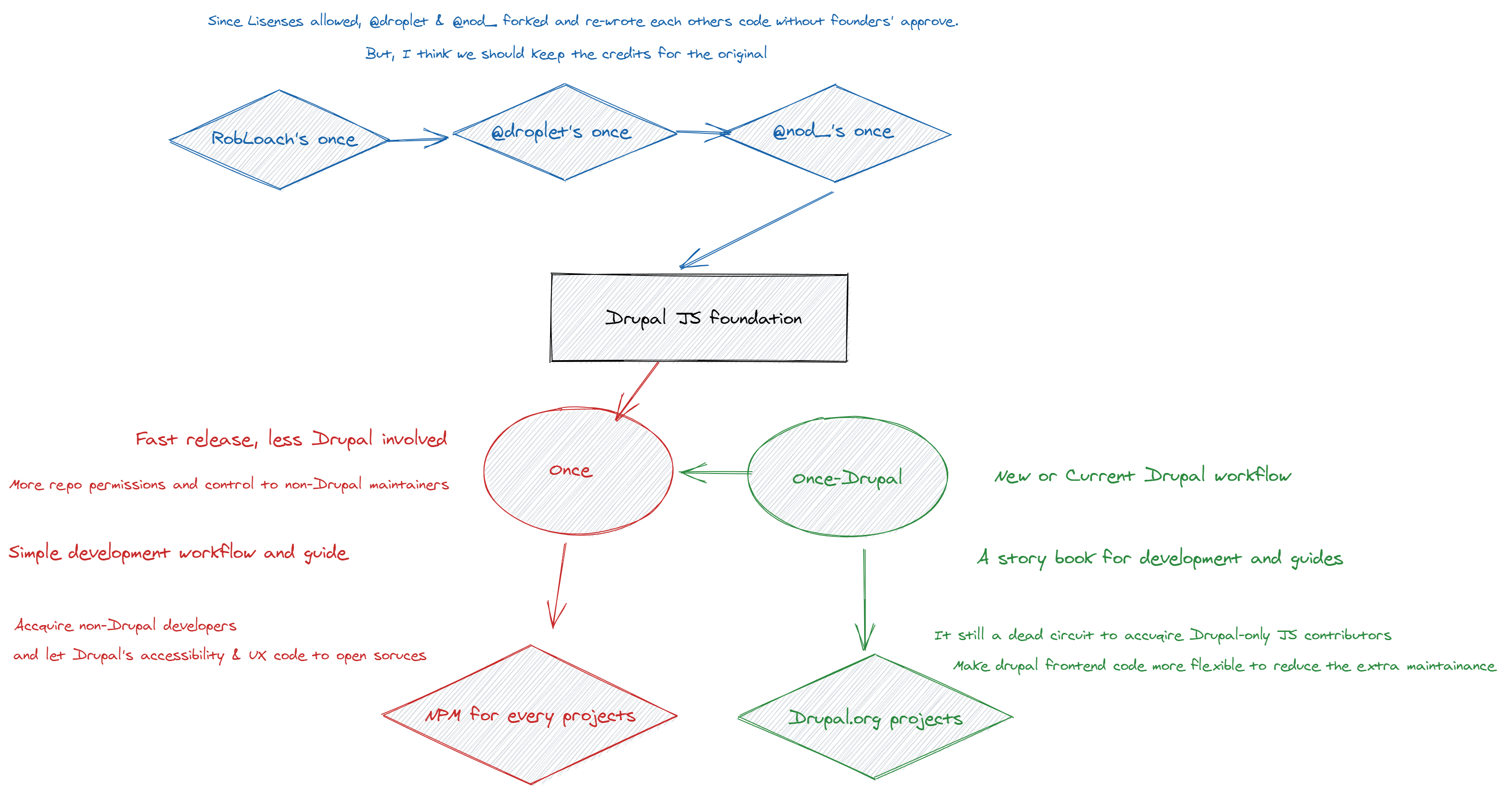
droplet commentedStopped discussions already? The current draft policy still very Drupal-specified. (I hope I'm wrong.) It's a dead circuit.
We have to make libraries reusable everywhere and able to acquire NON-drupal developers.
@see Chart below (click the link above for large version)
Make Drupal Theme the same way, then we have a good Bootstrap-like framework for everyone. It's good for Drupal.
** chart source: https://excalidraw.com/#json=5726368989970432,GpM7O2zIggaa43ZUOBUdGg
Comment #35
nod_I think that's what we have in mind (that's what I have in mind at least), now it's mainly a matter of formalizing the proposal (in the google doc) and figuring out the details. The aim is not to create new Drupal things. I see this as moving existing Drupal things that are better, in a different community (code of conduct, core gates around accessibility/documentation/code quality, handling of security issues, etc.)
To me this is not really about code, today we can still go the way RobLoach did for jquery-once and have a faster releases, there is nothing stopping us to create the once lib and submit it as a third party lib, same for autocomplete, events, etc. What's missing is an official way of managing "Drupal-supported" code outside drupal.org, for smaller libs it's not critical, but it's critical for the js menu component initiative because the third party approach is not what is wanted.
Fork to github to add Drupal-specific things to libraries is already the policy on the PHP side #2157189-26: [Policy, no patch] How to handle upstream fixes that don't get committed fast enough, and I think we didn't go this way for jQuery UI because those forks are supposed to be temporary. Having an official policy would solve that.
Comment #36
nod_Had a chat with gabesullice and lauriii about this and we discussed the different assumptions/expectations we had since a few things didn't match with what I tried to address in the summary. To me what's in the doc linked in #33 goes a little too far for a first step and try to address some issues that are out of scope for what I want to solve.
I spelled out what I had in mind for the policies in this a separate doc the difference is that it's a smaller scope. Essentially it is to give the use of the "drupal" space in github/npm to trusted maintainers that will manage libraries used by Drupal core and make sure they work well and keep a good quality. The document is not editable it is only there for discussion, main work should happen in the existing google doc.
Comment #37
hestenetThe Drupal Association had our regular monthly check-in call with core maintainers today, and naturally this issue was a topic of some discussion.
@Lauriii raised some really thoughtful points, in particular, about some of the intangible impacts of our decision making.
Intangible Impacts
To paraphrase quickly:
This is raising some new questions for me, and makes me want to hear from the current initiative participants, and javascript devs in general about what's important to them.
I know these intangible questions are very squishy and touchy feely - but understanding the answers would help bring us a lot closer to understanding the best way to solve the tooling and governance issues, I think.
For example, if the most important intangible element is 'being able to receive contribution from Drupal outsiders' that would suggest a different route than if the most important thing is 'being present within the Drupal community'.
Middle ground solution: Drupal.org + GitLab
When I think about all the ways that we've recently worked on making different kinds of contribution recognizable within Drupal, it at least makes me want to *offer* the best possible foot forward that Drupal.org could provide.
Remember, Drupal.org's git backbone is now GitLab and that does give us a lot of power.
We could:
These are all things we could do so that these Javascript efforts (and any other non-php Drupal efforts) can be first-class citizens of the project - with credit, d.o visibility, d.o documentation support, governance, etc - and the DA is absolutely willing to invest in that.
In the meantime, pre-release development of the new component could continue on GitHub, and we can compare feature by feature as the DA adds new capabilities.
How does that strike you all? Very curious for all of your thoughts.
Comment #38
nod_Very interesting questions, I was feeling like I didn't get my point across, with these questions I'm starting to see from a different point of view and better understand what other concerns there are around the topic.
First, let's acknowledge that a Drupal JS community already exists on github, folks making projects with React/Vue use github, not drupal.org. I want to support that and not try to force them back on drupal.org. We can help by bringing some pieces of the Drupal community on github and put some official framing around all that (the policy document). This issue is not going to create something that is not already there, what I'm proposing is aimed at improving the situation both for core and folks using github.
Ideally, I want people without a drupal.org account to be Drupal contributors, I want them to be able to contribute to some parts of Drupal JS code, documentation, architecture, etc. from where they are already comfortable.. This is pretty central to what I have in mind, and the policy and different suggestions are a pretty much a way to define what a Drupal contributor is outside Drupal.org, and explain to other developers what to expect when working with and working on Drupal JS code. You're contributing to github.com/drupal/once => boum you're a Drupal contributor. You can expect X/Y from us, and we need Z from you.
With my JS maintainer hat (not talking on behalf of any of the initiatives), to me there are 2 different situation here:
Back to your questions:
Have a healthy Drupal JS community that is in touch with the rest of the Drupal community.
For A: no, it doesn't matter. these are libraries that have Drupal as the main user so they need to cater to Drupal needs but not only.
For B: no, the main people supposed to use it are not on drupal.org so there is little benefit, also everything is already on github today.
No, people contributing might not even have a drupal.org account. It's better but if it create any friction to contribution it's better to do without.
Work should be visible to the target users. So I would say yes to some extend, but not at the cost of the people working on the project (fed up with lack of progress, reactivity, etc.). And for A, I'd want the work to be visible to the whole JS community, not just Drupal.
It's the most important point. and probably why everything is already on github.
Yes, second most important point. Although like I proposed above, they wouldn't be outsiders anymore.
I would like to point out the waterwheel effort from Acquia which was similar to what is underway for the new JS initiative, there was a drupal.org module then replaced with a github repo. People involved there would have some ideas about why a move was necessary.
Quick note on the middle ground solution: Drupal.org + GitLab: I appreciate the willingness to be open about alternatives. As a maintainer I would welcome the possibility to run common JS tools with gitlab CI and have the JSDoc api published officially. This wouldn't solve the "take people where they already are" point, but it'd be much better than what we do now for folks still on drupal.org.
To me we're well past the point of trying to stop people from going outside of drupal.org. I'm for supporting them because it'll take way less effort than trying to make a home on drupal.org with a patchwork of tools. Why not try it this way? The most visible thing we have to show for our past efforts is a trail of burnouts, pretty sure we can do better this time.
Comment #39
nod_Quick note on github, by now there are many IDE integrations which means PR can be created, reviewed and merged within PhpStorm, or VSCode. Gitlab plugins exists but they have much less features. If a middle ground is found with d.o + Gitlab, the developer experience will not be close to what can be achieved on github.
Comment #40
mirom commentedI added some licensing recommendations based on the JS modernization iniatiative to the document - https://docs.google.com/document/d/1LkTeRac_UmEsXNx5du3IfXDwHEeR2nvw9zei...
Comment #41
droplet commentedSomething happened today:
1.
I got the Drupal's Gitlab email today. At first sight, this is adding another extra layer to block your contribution more than help. I can't 100% tell what that Drupal Gitlab is and how it works by the way.
Simple tooling has never been a problem for developers, at least not for senior developers(, real contributors). Now, I can still fork it to use github/gitlab.com and that's FREE also.
2.
https://www.drupal.org/project/ideas/issues/2913628#comment-13686894
This is my first time knowing that an issue about Menu thing. That's 2 months late.
Who are they? Drupal site builder? or anyone?
Comment #42
nod_About 2. I think in general there is a lot going on in chat (IRC and now Slack) that you end up missing out on. There are some discussions that are not well suited for the d.o issue queue. Getting an initiative organized is one of them, the process to propose a new initiative is documented and has to go through this different issue queue on purpose to not get in the way of technical core work. That is a discovery problem you're correct, the way people hear about the initiatives somethings like :
People hear about the topic in Dries keynote, or read about it in Dries blog post (which is cross posted on the drupal blog), then they get on Slack and start discussing in #contribute channel, or they see a tweet about it, and start discussing in the dedicated slack channel to organize. If you're not (or can't ) be on twitter or slack it'll be hard to be informed. Where would you see it?
On the Drupal contributor thing it's my personal opinion but I would like anyone to be a drupal contributor. A rando on github fixing a typo in the documentation of the once lib => they are a Drupal contributor now. I don't know how to associate contribution credits for that but we can find something later, right now I'm interested to see if we can agree on the principle.
Comment #43
hestenetI've made a quick and dirty demo of how the D.O issue queue integration with merge requests presently works, just to provide something more concrete around that option: https://youtu.be/NIWCXE-aM6Y
Comment #44
gabesulliceIf you have not been paying careful attention to the google doc, now is the time to sit down with it.
Please be sure to read the section on page 1 titled How to read and contribute to this document. Following those suggestions will ensure that no discussion gets forgotten/overlooked.
Our goal should be to alter the document until it represents something that we all agree on, not to decide up or down on exactly what it looks like today.
The first thing on your mind will probably be: Why does the doc look the way it does?
Since we tried to be extremely thorough and to consider every implication of our recommendations, from licensing to security coverage to governance (however small), it would be very difficult to discuss all the details via comments in this issue.
By using the RFC style (borrowed from the IETF and many, other, OSS projects) we can have discussions about specific details and collaboratively work toward a consensus on them without anything getting lost in the noise.
Comment #45
justafishI strongly disagree with this!
I'm +1 to @nod_'s sentiments
Comment #46
fgmJust went through the whole issue, and now I wonder what in this is really JS-specific. Couldn't the consideration be extended to PHP components too, for the same reasons ?
Consider a very popular one like commerceguys/intl, for example. Used by lots of projects beyond Drupal, but still very much tied to Drupal, although for a contrib, not for core. Or the scaffold projects, currently on github.
Wouldn't these benefit from the same approach ? This would allow us to export some code (thinking of core/lib/Drupal/Component, specifically), to allow them independent maintenance instead of being just splits from core.
Comment #47
nod_I think that could be the case, it's just that starting with JS where there is no history or "official" integrations with existing package systems is easier in that we don't have to deal with existing things. I don't have a good answer for php, might need to ping catch or alexpott about that :)
Comment #48
gabesulliceI think all the stakeholders have had time to weigh in on this. Uploading the Google Doc as a PDF so we never lose access to it (hopefully). There are still a few remaining TODOs and QUESTIONs, but I think we need to hash those out in practice within the library itself and the DA.
The DA has begun implementing many of the recommendations that it makes, @justafish and @nod_ have been appointed as new core committers to govern JS.
https://www.drupal.org/project/once has been published.
The next major milestone will be publishing that library to NPM.
Hopefully we can refer back to the doc to resolve some questions in the future :)
Our remaining tasks are as follows:
Remaining tasks
Agree this is a good ideaDefine a set of policy recommendations in this Google docIOW, I think it's a little too soon to say we've have completed since the project linked above doesn't have any releases on NPM, but we're close!
Once that happens, I think we can move to canonicalization/adoption of the RFC/policies and fill in any gaps and remove the TODOs/QUESTIONs in it.
Comment #49
gabesulliceActually, Active is still more accurate, I think.
Comment #50
droplet commentedI scanned 20 pages. My summary is: "To share Drupal code to non-Drupal only"
It's very different from my expectations: To encourage and acquire more contributions [easy access & management + less Drupalism + better marketing portal].
I suspect this is what the original poster wanted also. Whatever, if this issue ends up in the current direction, I have another (better) suggestion.
First, isn't it more strict rules than Core development? (only 3.2.1 is more than Core.)
If so, why not change a bit of test standard in the current CORE development (, the only blocker) and build an automatic way to push part of code (components) to NPM. (It's very common in open sources) (Even as @fgm in #46 said: Make it to every components)
In Drupal (JS), the problem isn't a lack of committer to trigger Git. We have 100% RTBC patches commit rate. That's not enough Reviewer to set RTBC. Old contributors have no motivation and left the community or seek their own way to maintain patches privately
https://www.drupal.org/project/drupal/issues/2706483
Above 20 pages creating new (less power) maintainers. (and I can predict that's a very small group and may be the same current Core maintainers, no new players)
Now you can create a new role "SUPER REVIEWER" (as a virtual maintainer of this issue's suggestion.) and commit their work first. It's less work & confuses than the current new SPEC way.
Comment #51
nod_I must say it ended up different from my early expectations too (to be clear, I'm ok with how it ended up), I made the proposal to create a new "position" with the idea that it was hard to add people to the core committer team, thanks to this document, it was not hard.
The main benefit of this document is that it explained to core committers what it means to maintain a JS library. You know what it means, justafish know, I know, many other know in the JS issue queue, but it was not clear for all core committers. It made it less "scary" or "worrying" and made it easy to add people to the core committer team, because it's clear what they will need to do.
We ended up with justafish and I added to the core committer team as (provisional) core committer with an area of focus on JavaScript, we're not product/release/framework manager, "just" core committers (kind of like the "super reviewer" you talked about) and we're going to put what this document talks about in practice.
A few things I learned/realized during this whole thing that can help explain the situation:
It's only a first step, we will keep improving things
Now I know that things are still slow and I have made a few things to start addressing the review problem, because I agree with you that "adding more people" will not solve the issue (but it will help). My personal worry about JS patches is that a review and RTBC doesn't guarantee a "quick" commit. You are correct that we have a 100% commit rate for RTBC patches, the problem is velocity. I personally need to know that when I invest time in a patch, it'll be addressed quickly and the path to RTBC/Commit is clear and "fast". Having the ability to commit patches means that when justafish or I make a review, once the feedback is addressed we can commit and move on to other patches (if we didn't forget something during review, always possible :)
So to address the velocity:
There is progress, not as radical as we thought/hoped but we got some pretty important policies cleared up and it's still huge progress compared to just a few months ago.
Comment #52
nod_Update
At the moment, and thanks to justafish, we have a workflow that can publish to @drupal/once from drupal.org gitlabci instance, and security scanner configured to warn us when there are security releases of package dependencies.
TODO
Comment #57
borisson_Do the updates in #51 and #52 mean that this policy issue can be closed?
Comment #59
quietone commentedAccording to #52 there are documentation updates to do. What needs to be documented? Since this is tagged for an issue summary updated, it isn't clear if the information is the proposed resolution has been agreed to or not. At least, not to me.
What are the decisions here that need to be documented?
Comment #60
smustgrave commentedWanted to bump this 1 more time or if it can be closed?
Comment #61
quietone commentedWorking on reviewing this in detail with support from @nod_.
Comment #62
quietone commentedCreated #3559157: Add 'Core JavaScript packages' core committers
The document needs to be reviewed to make sure it is using the new names for the core leadership team. For example, Drupal now longer has a BDFL.
And which guide will this be put into?
Comment #64
quietone commented