Active
Project:
Contact
Version:
1.x-dev
Component:
Code
Priority:
Normal
Category:
Bug report
Assigned:
Unassigned
Issue tags:
Reporter:
Created:
24 Jul 2021 at 15:40 UTC
Updated:
24 Feb 2026 at 03:08 UTC
Jump to comment: Most recent


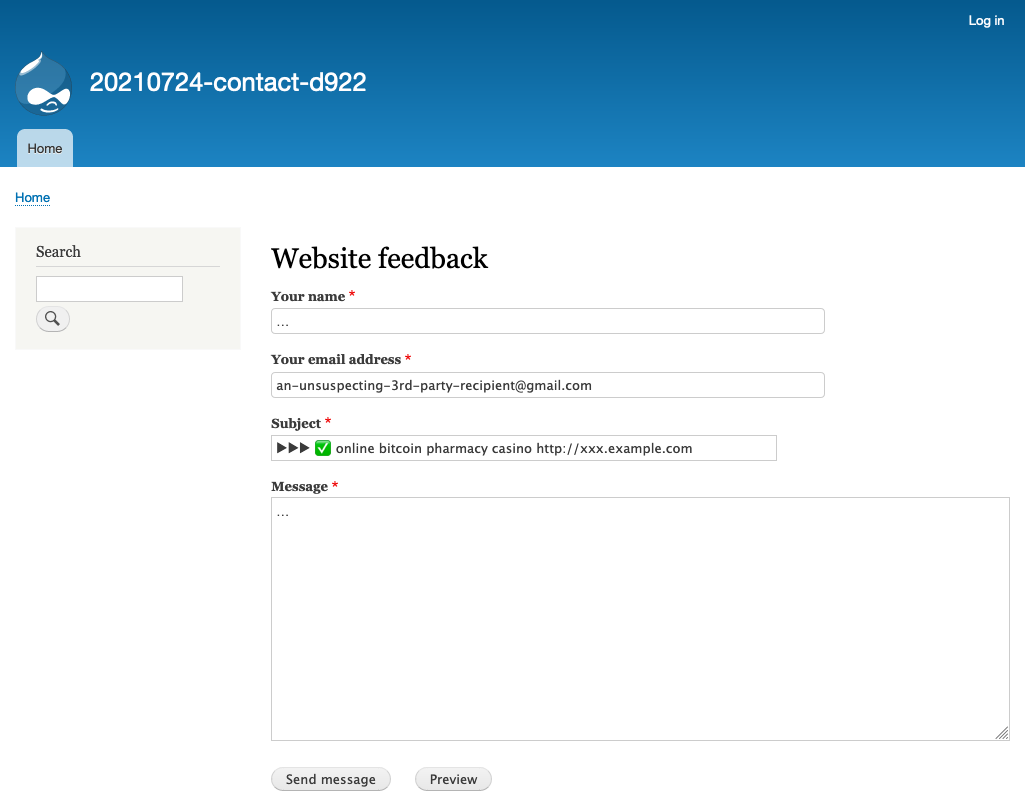
When a contact form's auto-reply message is enabled, spammers can put their message in the "Subject" field, put a 3rd-party email address in the "Your email address" field, and thereby use your Drupal site to send spam to other people. This is a kind of backscatter attack vector.
| Spammer fills out contact form with their message in the "Subject" field, and a 3rd-party email address in the "Your email address" field | 3rd party receives unsolicited spam message |
|---|---|
 |
 |
When the contact form auto-reply is enabled, Drupal should not include user-submitted content in the auto-reply email. Drupal could either use a predefined subject line (e.g. "[contact-form-name] site-name"), or provide a field into which the site maintainer can enter their own subject line. Then, when spammers attempt to use your Drupal site as a spam relay, 3rd parties would still receive unexpected emails, but those emails would not contain the spammer's message — thus removing the incentive for the spammer to exploit your site's contact forms.
Related: If #405338: Contact form: Add token functionaltiy is implemented, it should prevent using tokens containing user-submitted content, or (if tokens containing user-submitted content are permitted and used) show a warning stating that the contact form will potentially be used as a spam relay.
| Comment | File | Size | Author |
|---|---|---|---|
| Screen Shot 2021-07-24 at 10.48.07 AM.png | 53.02 KB | smokris | |
| Screenshot 2021-07-24 at 10-47-07 Website feedback 20210724-contact-d922.png | 43.4 KB | smokris |



Comments
Comment #2
cilefen commentedThere is some discussion on this related issue.
Comment #3
larowlanShould this be a private issue? Webform had an SA and private issue for a similar vulnerability
Comment #4
cilefen commentedhttps://www.drupal.org/sa-contrib-2021-004
Webform’s fix is probably the way to go. Lee, I’ve held opposing (with myself) views on spamming an obviously spammable form being public. Your call.
Comment #5
larowlanThe webform fix was to only mail logged in users.
Perhaps that's what we should do here too. Would require #601776: Remove the ability of registered users to change the sender name or email address in contact forms. too.
Comment #10
poker10 commentedAdding a missing tag.
Comment #11
quietone commentedThe Contact Module was approved for removal in #3476879: [Policy] Move Contact module to contrib.
This is Postponed. The status is set according to two policies. The Remove a core extension and move it to a contributed project and the Extensions approved for removal policies.
The deprecation work is in #3520460: [meta] Tasks to deprecate the Contact module and the removal work in #3520466: [meta] Tasks to remove Contact module.
Contact will be moved to a contributed project after the Drupal 12.x branch is open.
Comment #13
andypost