Closed (fixed)
Project:
Panels
Version:
7.x-3.3
Component:
API
Priority:
Normal
Category:
Support request
Assigned:
Unassigned
Reporter:
Created:
2 Mar 2013 at 12:04 UTC
Updated:
26 Mar 2013 at 18:40 UTC
Jump to comment: Most recent file


I want to hook into the output of the default panels ui editor (not IPE). My changes would be fairly simple and don't need to alter the logic behind the display renderer. Currently all that I would like to do is to add some CSS classes to the HTML containers generated by the panels_editor_renderer display renderer. For example inserting classes to the wrapper element on the Editor UI page: <div class="panel-pane panel-portlet my-new-class-name" id="panel-pane-1" />. Is there a hook that I could use?
| Comment | File | Size | Author |
|---|---|---|---|
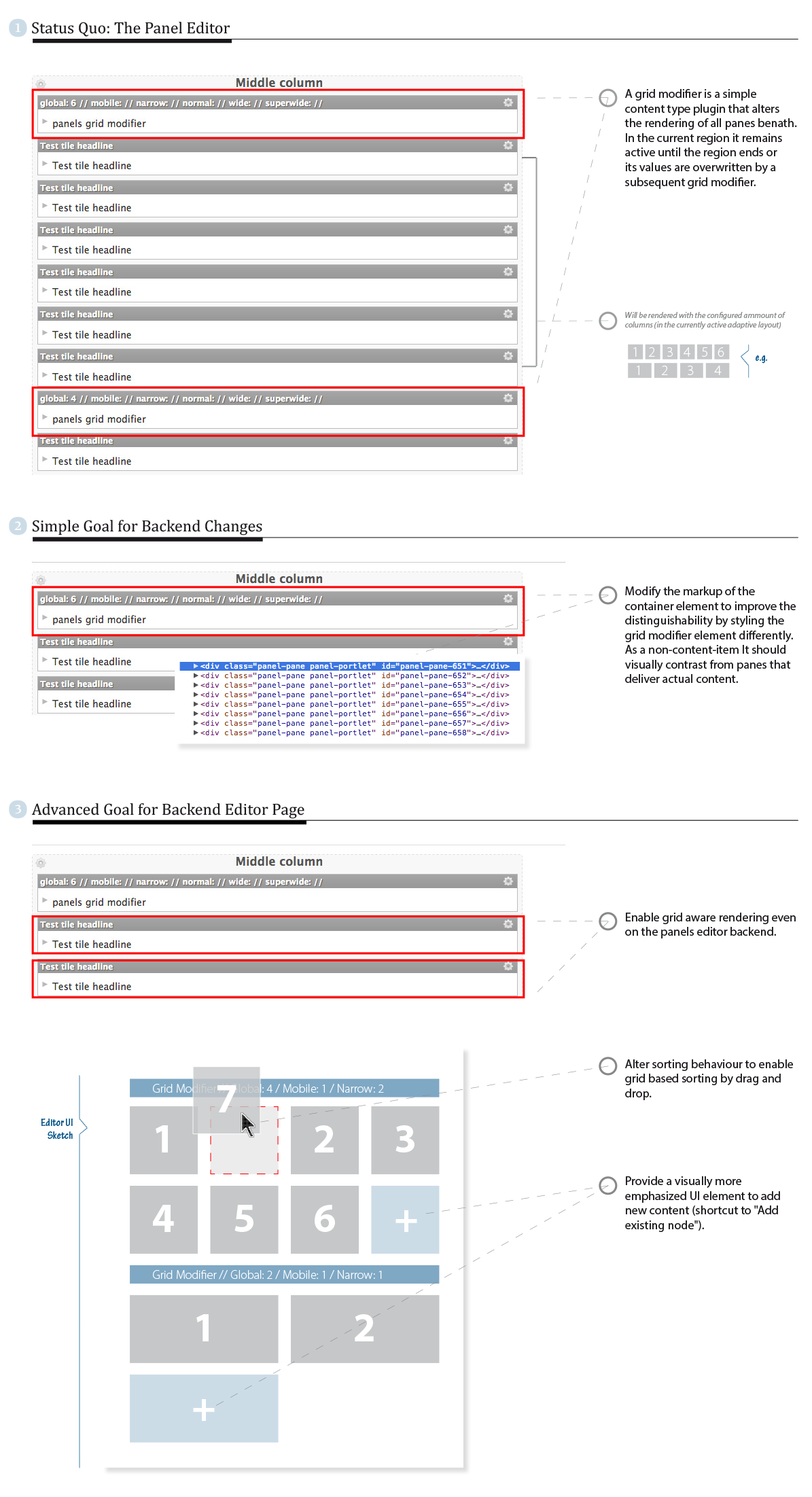
| #2 | Grid Modifier Backend Sketch | 442.4 KB | sthzg |

Comments
Comment #1
merlinofchaos commentedAt the moment, there really isn't. It had always been our intention to upgrade the backend editor to be a little more flexible that way, but very few use cases to do so ever presented themselves, so no time was ever spent on it.
The best thing I can think to do would be to use hook_ctools_plugin_post_alter() and change out the handler class. You can subclass the editor and make changes that way. It is likely mildly dangerous to do so, but it might allow you to make the changes you want. I don't know for sure, though; to my knowledge no one has ever tried it.
Comment #2
sthzg commentedThanks for your reply. Subclassing seems like an interesting approach, but I guess it would mean monitoring and testing panels updates very closely. My use case is derived from a small content type plugin that acts as a modifier to the rendering of panes beneath it (all it really does is adding classes based on its settings). I'm thinking about the effort to enable the backend to visually represent the effects of the modifiers on the edit page. I figured out two degrees of adaptions (added as a concept sketch to the ticket under 2 and 3). The first one (modifying the markup of the editor containers) would only bring small benefits. I'm not sure if this bares any relation to interfere with as deep as the render layer of the panels editor interface. The second one would definitely yield a great deal of usability; but I guess there are quite a lot of things that could go wrong and maintenance could become a burden.
I'll dig into hook_ctools_plugin_post_alter() and look at the code of the panels standard renderer as well as contrib modules that provide their own display render plugins.
Comment #3
merlinofchaos commentedAhh, grids. That can make things complex.
What I think you actually may want is a feature that I've never even started (so it doesn't really help you) but that I've wanted for several years now. It's something that would fix a lot of weaknesses. And that's a container pane.
A container pane has no content of its own; but instead, it has drag handles inside of it. That allows you to visually group together panes, and the container can provide markup around those panes. It would completely solve at least one of your problems. Though having that big + link which is a shortcut to adding a particular piece of content is...very specialized and somewhat harder. It may not be completely impossible. When you drag around a container pane, all the panes inside it go with it.
Container panes may not actually be that hard. It depends upon how difficult it would be to add a new kind of region into the drag & drop editor system, and more importantly, how much one would have to change the backend data structure since right now panes can only actually live in regions.
Comment #4
sthzg commentedOkay, just a little brainstorming... If I get it right the markup for the panels editor main wrapper is assembled in the render() method of the panels_editor_renderer class. When I dump $this I see that we know a lot about the regions and their region styles at this point. In terms of architecture, would it be a problem if during the bootstrap there was a possibility to hook into the phase when all information that is known at the render() stage is available (but before render() does it's job)?
This hook enables module developers to check the styles for each region. If a region or panel style matches something intended by the module developer (in this case the region has the style grid_container) the module developer could access the Drupal.settings object and register alternative behavior for the JS rendering of that particular region's panel-portlet logic (display_editor.js?). Maybe a mixin or just a callback that is triggered right after the default panels editor has done it's work.
That way a content type plugin that implements that hook could also alter behavior in the backend. When I think about my use case there is no need for an additional data model – if there was a way to make the adapted sorting logic communicate new pane order to the already existing panels logic.
-----
When you were thinking about the container layer – have you had an idea where to put it (in terms of configuartion/workflow)? Should this be something that is added over the panels editor interface, like »click region gear > add content > containers > container« or at the same level as regions and layouts are defined? (Although the latter sounds a bit inflexible)
-----
Short update: haven't had the time to dive into this so far. I hope for the weekend to come to try some of the hints given so far.
Comment #5.0
(not verified) commented- Example markup in the ticket not visible