Problem / Motivation
When using the page cache, we will generate the following HTTP headers when we need to by-pass the cache:
Cache-Control: must-revalidate, no-cache, private
This appears to be the intended behavior per https://git.drupalcode.org/project/drupal/-/blob/11.x/core/modules/page_...
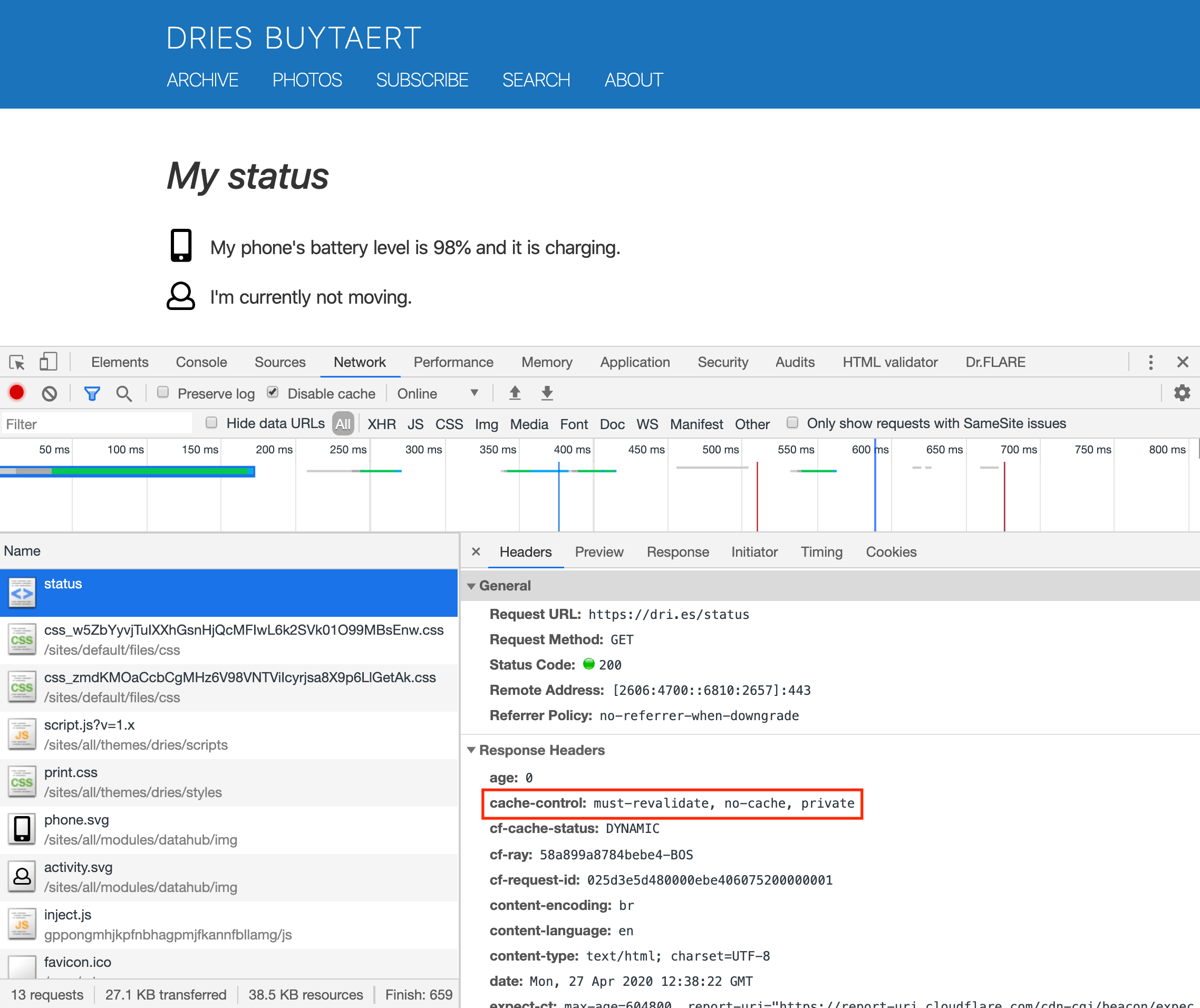
This is also what happens when you use the page cache kill switch: \Drupal::service('page_cache_kill_switch')->trigger();. You can also see this in action by inspecting the headers of https://dri.es/status.
The problem is that this is a bad way to tell a browser and any proxy cache not to cache a page:
must-revalidate means that the cache must not use the resource after it becomes stale. It needs to first revalidate the request with the origin server.no-cache means the resource can be cached, but that it must be revalidated each time before using it. The name of the header is somewhat counter-intuitive.private means that the resource can't be cached by proxies (e.g. Varnish, CDN), but that it is ok for a browser to cache the resource.
In other words, these headers are at odds with one another:
no-cache allows caching by proxies but requires revalidation. This makes must-revalidate redundant.private disallows caching by proxies (only the browser can cache). This is at odds with no-cache which allows proxies to cache the resource, as long they always revalidate first.
Proposed Resolution
It is better to use the following header:
Cache-Control: no-store
no-store means that the resource can't be stored by any cache, including the browser's cache.
There appear to be two parts to the fix:
- Change behavior of
FinishResponseSubscriber::setCacheControlNoCache() and added a new function FinishResponseSubscriber::setCacheControlNoStore(). setCacheControlNoCache() is no longer used in core, but given that it is a protected method, it might be used by contributed modules. I don't think we can remove it. An alternative solution is to change the implementation of setCacheControlNoCache(), and not introduce setCacheControlNoStore().
private and no-cache are set at the same time because $response->headers->set() appends headers by default. This is fixed by setting the 3rd parameter to TRUE.
Behavior Changes
Question: When this fix is applied, what will change about how Drupal is cached?
Answer: This will improve the browser's back button behavior for authenticated users: after the user logs out, its no longer possible to see browsers cached content with back-button. This is true for Chrome, Edge, Firefox. Safari has an bug on handling Cache-Control headers and there behavior does not change. If we find a work-a-round, we can implement it on #1912514: Using the back button after logging out shows you pages from the authenticated user's session


 Show commands
 changes
Comments
Comment #2
wim leersno-cache, must-revalidateoriginates from Drupal 7: https://git.drupalcode.org/project/drupal/-/blob/7.x/includes/bootstrap..... That's also what\Drupal\Core\EventSubscriber\FinishResponseSubscriber::setCacheControlNoCache()in D8/D9 does.privateis AFAICT only added for authenticated users. The test expectations prove this, and you even quote that at the beginning of the issue summary. So, expanding the issue title.In my experience, it's almost never quite this simple. There's a lot of dark magic and obscure knowledge in
Cache-Controlresponse directive land. I did some digging and found:IOW:
no-storebreaks the browser's "back button cache".Based on my digging, this seems accurate though:
Curious what Page Cache maintainer @znerol thinks!
Comment #3
dries commentedI believe my current patch only affects the kill switch,
\Drupal::service('page_cache_kill_switch')->trigger(). The kill switch is applied to anonymous users, so it's not strictly for authenticated users. As you can see from the screenshotprivateget added toCache-Control, even for anonymous visitors. Try it at https://dri.es/status.Comment #5
kirkkalaThanks, we needed this header change after a security audit finding.
The original patch though has `docroot/` in paths which causes it to fail from applying. Re-adding with fixed paths.
Comment #7
josephdpurcell commentedI know this ticket is technical in its focus, but I'm curious if there was a functional issue that prompted this ticket? I found this when digging into #1912514: Using the back button after logging out shows you pages from the authenticated user's session. I'm going to set this ticket as related, in the event that no-store affects the other ticket.
Comment #8
josephdpurcell commentedTesting results on Drupal 8.9.1 using Firefox 78.0.2.
Note: when testing locally, ensure you do not have "Vary: Cookie" as a header in the server response.
Test scenario: logged in then logged out, "Back" does not show authenticated cache
Before applying patch #5
* Go to login page: GET request at /user/login has header: cache-control: max-age=1800, public
* Attempt login with invalid credentials: POST /user/login has header: cache-control: must-revalidate, no-cache, private
* Attempt login with valid credentials: POST /user/login has header: cache-control: must-revalidate, no-cache, private
* User is redirected on login: GET /user/123 has header: cache-control: must-revalidate, no-cache, private
* Logout: GET /user/logout has header: cache-control: must-revalidate, no-cache, private
* User is redirected on logout: GET / has header: cache-control: max-age=1800, public
* Click the "Back" button in the browser: GET /user/123 is served from browser cache and shows the user is logged in (e.g. Drupal admin toolbar is present)
After applying patch #5
* Go to login page: GET request at /user/login has header: cache-control: max-age=1800, public
* Attempt login with invalid credentials: POST /user/login has header: cache-control: no-store, private
* Attempt login with valid credentials: POST /user/login has header: cache-control: no-store, private
* User is redirected on login: GET /user/123 has header: cache-control: no-store, private
* Logout: GET /user/logout has header: cache-control: no-store, private
* User is redirected on logout: GET / has header: cache-control: max-age=1800, public
* Click the "Back" button in the browser: GET /user/123 returns a 403 forbidden
Test scenario: logged out then logged in, "Back" does not show anonymous cache
Assume there is an about us page at /about-us.
Before applying patch #5
* Go to about page: GET request at /about-us has header: cache-control: max-age=1800, public
* Go to login page: GET request at /user/login has header: cache-control: max-age=1800, public
* Attempt login with valid credentials: POST /user/login has header: cache-control: no-store, private
* User is redirected on login: GET /user/123 has header: cache-control: no-store, private
* Click the "Back" button in the browser and select About page: GET /about-us is served from cache and shows the user is not logged in (e.g. Drupal admin toolbar is missing)
After applying patch #5
Same results.
My interest in testing is for #1912514. It appears this patch #5 is a potential solution for it. Thanks for submitting!
I did not test on a fresh Drupal install. Given how severe of an impact this could have, it would be good to see automated tests and perhaps some anecdotes from anyone using this approach on a live site. It would also be good to get more input on the cache-control choice, based on comment #2 it sounds like it might not be clear what the header value should be for certain? Also, it sounds like this change would affect some behavior of Drupal which should be documented.
Comment #10
roderikComment #12
cilefen commentedComment #14
mpp commentedDrupal 7 has the same conflicting cache directives.
Replaced must-revalidate (force browser to revalidate cache) by no-store (avoid caching in the browser).
From a security perspective, this is an important difference: we should avoid caching personal data in the browser.
Comment #16
johnwebdev commentedRegarding the behavior changes, #3209204-8: Adding existing translation throws "Invalid translation language specified" illustrates an example where that bug behaves differently depending on the browser you use. With this patch change, the Chrome behavior works as the Edge one, which IMO is the right behavior.
Comment #19
weekbeforenextThe patch from comment #5 worked for me in 9.4.9. I created a new patch to include fixes to the failing tests (hopefully).
Comment #20
_utsavsharma commentedFixed CCF for #19.
Comment #22
weekbeforenextUpdated the patch to fix more test failures.
Comment #23
weekbeforenextComment #25
weekbeforenextFixing test failures... again.
Comment #26
weekbeforenextComment #27
znerol commentedI disagree for the reasons already stated in #2. The approach taken here is very probably overzealous and has the potential to badly affect UX.
I propose to postpone this and then reevaluate after the
Varyheader has been fixed in #1912514: Using the back button after logging out shows you pages from the authenticated user's session.Comment #29
johnvAs I understand, the page_cache module is only intended for anonymous users, so moving to other component.
Comment #32
sokru commentedOn Slack @catch suggested moving this to "request processing system" since this is not cache subsystem issue. Cleaned the tags based on that.
The scope of this issue should be making sure the private information is not stored in browser disk. This will resolve the security scanner reports mention on #5. Changing the Cache-Control header from
must-revalidate, no-cacheintono-storefixes the #1912514: Using the back button after logging out shows you pages from the authenticated user's session on Firefox, Chrome, Edge, but not on Safari, see https://discussions.apple.com/thread/251817133. I'd suggest leaving that issue to solve issue with Safari.Comment #35
mxr576hm, does Safari also ignores must-understand Cache control value? :O
Comment #36
znerol commentedServing responses with
Cache-Control: no-storehas been the source of wicked UX issues in the past. This needs careful manual evaluation of multiple scenarios across popular browsers. Some scenarios are described in this rather old atlassion blog post.One scenario based on Drupal core alone could use the contact form together with a misconfigured e-mail transport. This accurately simulates a situation on a production site where a mail server isn't reachable for a short time. In this case an error message is displayed after the submit button has been pressed. My reaction as a user of this site would be to press the back button in order to get back to the text I've just written, either to save it to a file or to retry the form submission. On a site with
Cache-Control: no-store, I fear that the browser will render an empty contact form and that all text is gone.My hunch is that the
Cache-Control: no-storeresponse header should be used on specific routes, i.e., on pages which display sensitive / confidential data. Examples of this type of information would be social security number, personal health information or credit-card data. Forms which accept and pages which display this kind of data probably should supply their ownCache-Control: no-storeheader. And security audits will rightfully flag such pages if that isn't the case.Also please note that results of any automated reporting tools (including security scanners) need to be interpreted by people with knowledge in that particular field. Comment #5 gives no details about the type of application, the scope of the audit and the reason for the suggested change.
Comment #37
sokru commentedYes, Safari does ignore
must-understandwith back-button, Safari behavior is similar to other browser if the "disable cache" is selected on developer toolbar.It would be very beneficial to get these weird UX issues documented with repro steps. On core's
/contact/feedbackcontact form I was not able to find any difference betweenno-storeandmust-revalidate, no-cache, using browsers back & forward buttons.Or we could make Drupal more secure by default using
no-storeand if people need better caching, they could change the response header. Many times even the unpublished node title could contain confidential data.But I acknowledge there are risks of making this change, so it might be best just to close this issue and introduce a contrib module with eventSubscriber using Symfony's HeaderBag to get a desired Cache-Control header.
Comment #38
catchI think we need to manually test and document browser behaviour in the issue summary, marking needs work for that.