Problem/Motivation
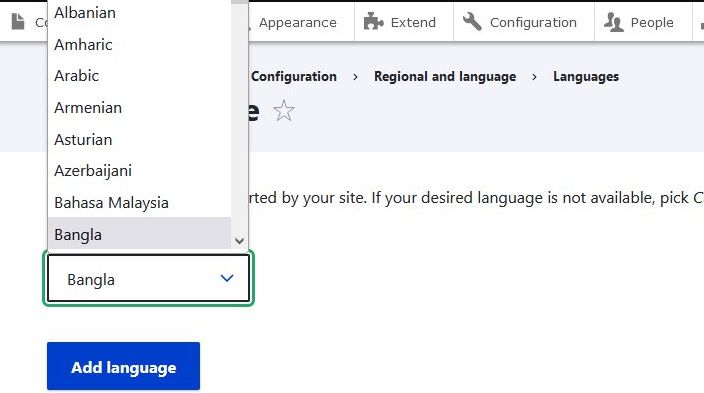
"Bengali" is the English name used on Bangla language in colonial period.
"Bangla" is the name used by most native speaker.
In the project i work on I made a group named "Bengali" but I noticed that the translators used the name "Bangla". I asked and I got this answer:
Bengali VS Bangali VS Bangla >>
Bengali = It is the way English language speakers say. It can meant in two ways.
(i) Addressing the people of either Bangladesh or West Bengal (India).
Example: "Are you Bengali" ? -> Means, "Are you Bangali" ?
(ii) Indicating the Language.
Example: "Do you speak Bengali" ? -> means "Do you speak Bangla" ?
Bangali = Indicates the ethnic group. It is the way people of this Sub-continent say.
Now, traditionally,
People from Bangladesh call themselves 'Bangladeshi', 'Bangali' and
People from West Bengal (Kolkata), India call themselves 'Bangali'
but the meaning of the word 'Bangali' is same, that is 'Who speaks the language Bangla' (basic form).
Bangla = Indicates The Language spoken by people from Bangladesh and West Bengal (India)
Bangla is also the name used for the language in the constitution of Bangladesh:
http://bdlaws.minlaw.gov.bd/act-367/section-24550.html
Steps to reproduce
Proposed resolution
Add a new entry for 'bn-bd' and change the existing one to 'bn-in'
Remaining tasks
Decide on the change
User interface changes
API changes
Data model changes
Release notes snippet



Comments
Comment #1
matsbla commentedAnd issue with intense discussion about this can be read at launchpad:
https://bugs.launchpad.net/ubuntu/+source/language-selector/+bug/991002
Comment #2
matsbla commentedComment #4
matsbla commentedComment #5
matsbla commentedComment #7
matsbla commentedComment #8
matsbla commentedTry again, correct the path in patch
Comment #10
matsbla commentedokay, someone please help me me find out why this patch is not working!
Comment #12
matsbla commentedComment #14
cosmicdreams commentedHello matsbla. I'll take a look at this tomorrow as it is midnight here. Thanks for your work on keeping this issue going.
Comment #15
sriharsha.uppuluri commentedI have updated the string
Comment #16
cosmicdreams commentedIn looking at the previous patches and this newest one, I have high degree of confidence that the new patch will pass the rest of the test suite. So I'll pre-emptively mark this as RTBC and if I'm wrong, testbot will downgrade to needs work.
Comment #18
cosmicdreams commentedThere seems to be something going on here with the test bot. There's no reason why this issue would need to run it's test on the same testbot multiple times. I don't see a way to remove the extra test bots, or at least I haven't found it yet.
Comment #19
matsbla commentedCool, thanks for the hand :) :)
Comment #20
tim.plunkettComment #21
xjmBased on https://bugs.launchpad.net/ubuntu/+source/language-selector/+bug/991002 it sounds like this is indeed the correct official name for the language. I am assuming that all language detection and translation is based on the language code, and the provided Bangla name for the language itself is unchanged, so changing its English label should not be disruptive.
I'm undecided on whether this change should be targeted against 8.0.x or 8.1.x at this point. The disruption seems low and it could be considered a bug to use an inaccurate, non-politically-correct name for the language. On the other hand, this does cause a small user interface change in the installer for the language, and since it also has some political implications, I'm leaning toward targeting this fix for 8.1.x. I'll also reach out to the Multilingual initiative lead for his perspective and confirmation.
Comment #22
gábor hojtsyDrupal works off of web standards as much as possible when dealing with language codes and names. I looked up the language code "bn" with the W3C language tags search tool (http://www.w3.org/International/articles/language-tags/) and that lists this language code as Bengali. Note that that is based on the IANA language tag registry which lists this language as Bengali as well, see http://www.iana.org/assignments/language-subtag-registry/language-subtag.... It does list a language named Bangala under the bxg language code. Not under the bn language code. Then there is the Unicode CLDR registry that also lists language codes (note that we refer to the W3C standards when there is a conflict between CLDR and W3C). In this case the CLDR lists Bengali as well and it does not even list Bangala at all. Drupal works in a larger web ecosystem and the apps needs a shared understanding on which language codes mean which languages. So based on the standards listings, I don't see this would keep Drupal in line with the standards we say we work with.
Comment #23
xjm@Gábor Hojtsy, so in that case are you recommending that this issue needs to be a won't fix?
Comment #24
matsbla commentedI asked at IANA language tag email list, they say that this name is part of ISO 639-2 (we are now in version 3). Changes in part 2 needs to be done by a "Library of Congress" which they say will probably not be done...
Why have Drupal chosen to follow W3C over CLDR in names? I'm not sure, but in CLDR I think it would at least be a fair chance to get the name corrected (and they even provide translations). As W3C import from IANA that import a lot from ISO 639, it is very difficult to change many names. So even when being offensive for people, many names then are mostly carved in stone. To me that sounds more like a fossil system than an ecosystem :)
Would it not make more sense to have the starting point in the native language name and simply see "Bengali" or "Bangla" as English translations of the name? Or why do we need to have the starting point in the English names used? Bengali could then be seen as a wrong translation, and I'm not sure why we should care that W3C use a wrong translation. I think Drupal provide their own translations of language names for other languages, right? So why not do the same for English?
Besides, I think the most important thing is to follow W3C on the language tags, not the English names used. I can understand you don't want to have a long pile of requests in the issue queue here at Drupal about language names, but then the names should at least come from a place where there is a fair chance to get them updated and corrected.
Comment #25
gábor hojtsyWell, the W3C sets standards for the web, there needs to be a common understanding between different tools as to what language means what. Even the CLDR lists Bangala under a different language code so if we would jump to conform to CLDR, we'd need to change the language code which comes with all kinds of backwards compatibility nightmares. Why does the CLDR list them as two different languages?
Comment #26
matsbla commentedThe "common understanding between different tools" comes from the language tag, not the name.
Obs! The name in this is issue is Bangla, not "Bangala".
Bangala is a language from Congo:
https://www.ethnologue.com/language/bxg
There are more than 6000 language in the world, of course there are several languages that have similar, and even same names. They are identified by W3C and software as different languages because of the language tag, not the names.
The link you gave is a standard for language tags, not names. It is possible to use different names for the same tag. I can change my language tag "es" to be names "Castilian" instead of "Spanish", but as long as I use the same language tag it still means the same thing according to W3C standard.
For CLDR I only say that it might be easier to correct/update the language name there. I do not advocate to change the language tag, only the name.
Comment #27
gábor hojtsyRight, my bad, sorry, misread that :/ It does not change the fact that the CLDR and W3C both disagree with the suggestion of this issue :/ While its true that technically things are identified by language code, if we'd change the label for 'es' to 'Greek', people would be hugely confused given that we mostly only display the label not the language code. In select boxes, admin tables, language selectors, etc. So we are trying to adhere not only to the codes but also the labels.
Comment #28
gábor hojtsyAlso as my misunderstanding showed, even tiny changes in language names mean different languages, so we need to be careful. That is why we try to not go our own path.
Comment #30
ramya balasubramanian commentedComment #31
Ramya Bala commentedComment #43
quietone commentedI asked in in #multilingual about this. @Gábor Hojtsy replied that the change should be done in code and on localize.d.o.
I've updated the link in the IS to the relevant section of The Constitution of the People’s Republic of Bangladesh.
After doing some reading I've learned that the current entry is correct for the version of the language spoken in India and the language code for it is 'bn-in', So, instead of changing the 'bn' entry to Bangla, should this instead change the existing one to bn-in and add a new one for bn-bd?
Comment #45
gaurav-mathur commentedPatch #29 tested. working fine. screen shot attached for reference.
Comment #46
quietone commented@gaurav-mathur, thanks for the interest in this issue. Unfortunately, this patch is not ready for testing. The proposed resolution section of the Issue Summary has not been discussed. To find issue that are ready for testing, I suggest searching the issue queue for issues tagged 'needs manual testing'. Also, check out the contributor tasks on Drupal.org that provide the steps for making useful additions to an issue.
Comment #48
needs-review-queue-bot commentedThe Needs Review Queue Bot tested this issue. It either no longer applies to Drupal core, or fails the Drupal core commit checks. Therefore, this issue status is now "Needs work".
Apart from a re-roll or rebase, this issue may need more work to address feedback in the issue or MR comments. To progress an issue, incorporate this feedback as part of the process of updating the issue. This helps other contributors to know what is outstanding.
Consult the Drupal Contributor Guide to find step-by-step guides for working with issues.