*** Advice ***
Multilang is deprecated in favor of its pretty improved successor, MMS, which can simply replace Multilang without loosing anything of the already translated content.
MMS is based on the same strategy and benefits of the same advantages plus the following:
- it covers any kind of content (nodes, blocks, menus, taxonomy, content types, field labels...) without the need of additional modules
- the user gets totally rid of the "multi" syntax, thanks to a new integrated widget
*** Issue with Firefox 39 ***
A known bug makes the Multilang CKEditor plugin to fail with Firefox 39. Don't worry: this bug is fixed in Firefox 40, officially announced to be released August 11, 2015 as of Firefox 39.0.3.
Description
This module is intended to allow entering all desired translations of a given content inside of a unique node, instead of having to create a separate node (with Multilingual Content) or a distinct field version (with Entity Translation) for each translation.
The benefits of using this method are mainly:
- when entering new content or updating an existing one, authors keep a total visibility upon all the translations at the same time
- a direct consequence is to reduce the risk of omitting to update the translations when an original content has been modified
- when a content includes a lot of lang-insensitive data (like images, links, or simply verbous HTML with a number of attributes), these parts don't have to be duplicated: only the textual parts must be entered as "multi" and rewritten in the different languages
- since it emulates the SPIP <multi> syntax, this method is nicely suitable to allow the direct migration of contents from this CMS, without the need of a painful data restructuration
- moreover, in the latter case, authors can maintain their previous work habits unchanged
For more information you may read the basic description and the more detailed full documentation.
Requirements
Requires the Internationalization option of i18n to be active.
 Common pitfall: for some reason, when no other language has been defined yet, Drupal leaves the (default) English language path prefix language code empty. In this situation, Multilang cannot default to this "empty" language, so its own output (including inline help) is empty too!
So don't forget to immediately control (at admin/config/regional/language/edit/en) that "Path prefix language code" is set to "en".
Recommended modules
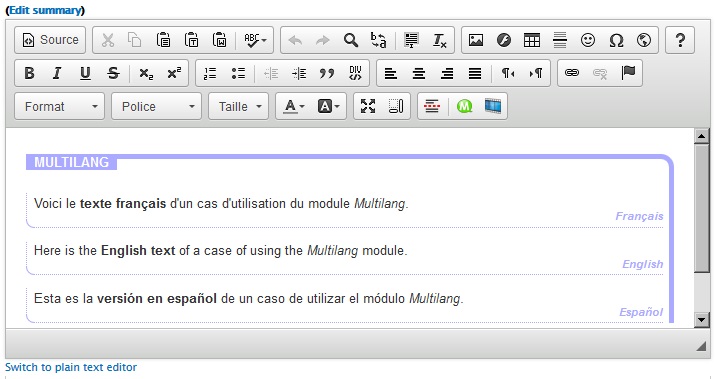
Best results are achieved when also using the CKEditor module (with Widget plugin): if present and activated, then the integrated Multilang plugin for CKEditor is activated too (see this screenshot).
NOTE: by cons Multilang is currently not enhanced yet for using it through the Wysiwyg module.
For simple text fields, an integrated widget allows direct input of each language text (see this screenshot).
Also designed to work with Pathauto and Views if they are active (see full documentation for detail).
Pledges
Currently no Drupal-8 version exists, but it should come...
Further versions might hopefully work with other Wysiwyg modules: volunteers having skills about Drupal integration of these alternative editors are welcome.
If you want to be involved in the localization process look at the Multilang localization center.
Sponsors
Development of Multilang is sponsored by p-interactif.
Project information
 Minimally maintained
Maintainers monitor issues, but fast responses are not guaranteed. Obsolete
Use of this project is deprecated.- Project categories: Content editing experience, Multilingual
- Created by cfreed on , updated
 Stable releases for this project are covered by the security advisory policy.
There are currently no supported stable releases.