

Closed (fixed)
Project:
Drupal core
Version:
8.0.x-dev
Component:
edit.module
Priority:
Major
Category:
Bug report
Assigned:
Issue tags:
Reporter:
Created:
19 Dec 2013 at 16:08 UTC
Updated:
29 Jul 2014 at 23:13 UTC
Jump to comment: Most recent, Most recent file




Comments
Comment #1
wim leersComment #2
wim leersComment #3
wim leersComment #4
wim leersComment #6
jessebeach commentedRerolled. Wim, please check
AppView::renderUpdatedFieldto make sure I integrated the changes correctly with the changes from #2075185: When an entity is in-place edited (i.e. saved), other instances of that entity on the same page are not updated (no propagation).Comment #7
jessebeach commentedOk, let's first prove the problem of zombie DOM elements exists. We'll do this by watching DOM node activity on the Timeline in Chrome. This is the procedure:
The following screenshot shows the sawtooth Timeline graphs of the steps (noted above) annotated on the graph.
Without the patch applied, we see a 32 node increase between editing activity.
With the patch, we see an 8 node increase. This, I presumed, was the entity toolbar that gets reused across editing instances.
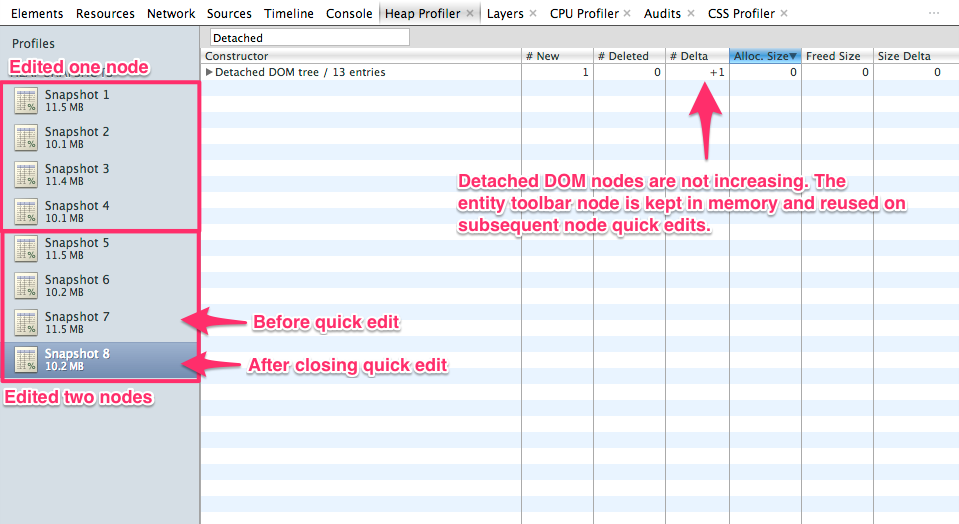
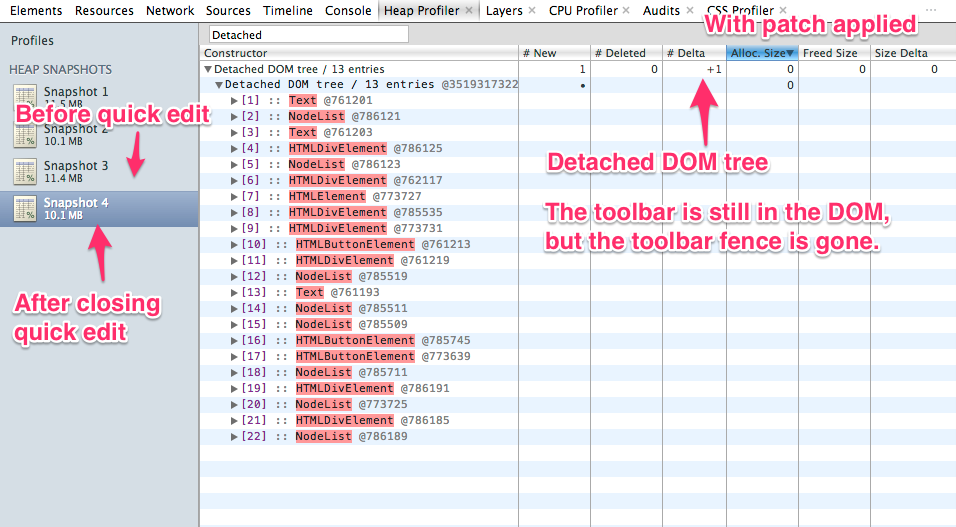
We can prove that the increase is nodes is due to Edit module comparing Heap snapshots from before and after quick edit sessions. The following four screenshots of the Chrome developer tools Heap Profiler show:
The conclusion is that the patch eliminates the accumulation of detached DOM nodes. The one DOM node that is added after a quick edit is launched is the element associated with the EntityToolbarView which is detached from the DOM when quick edit is cancelled, but it is not removed from memory so that the DOM can be reused.
Since I can't open Dreditor from the issue edit screen, I'll post this comment and then do a quick code review in a subsequent comment.
Comment #8
jessebeach commentedHow did this ever work if options is an object? You'd think it would have just errorred out. Bizarre.
Code changes look good. Manual testing shows no regressions. jsHint comes up clean.
Wim, can you just verify my reroll, the code I mentioned in comment #6?
Comment #9
wim leersThanks for all the work you put into this thorough review, Jesse! :)
#8: it worked fine, as long as
optionswas empty. And that was almost always the case.#6: it's very close, but a logic error has unfortunately slipped in: in the current code, the field model is always destroyed. After your changes, it's only being applied when propagation is enabled, which is incorrect — you've ironically introduced a new memory leak :D
However, I don't like my fix: the code is now pretty hard to follow. Do you see how you can make it simpler?
Comment #10
jessebeach commentedYou were right, Wim, my reroll did introduce another leak. The +8 nodes I saw in my original testing. I've retested your correction in the reroll and now we see a return to the baseline established after the first node is quick edited.
We start with 783 nodes, quick edit a node, end up with 795 nodes (the Entity Toolbar DOM fragment still in memory for re-use) and after editing another node, the node count drops back down to 795 again. Leak plugged.
The code looks great. Let's get this leak fix in.
Comment #11
jessebeach commentedComment #12
wim leersOh, yay: zero zombie DOM nodes :) I wasn't even aiming for that, but I guess we had few flaws to begin with :)
Comment #13
nod_Looks good to me +1 RTBC
Comment #14
webchickWow. That is some seriously impressive sleuthing here, folks!!
Committed and pushed to 8.x. Thanks!
Comment #15
wim leers