Dries Buytaert opened DrupalCon Rotterdam with a tour of a platform moving at remarkable speed. Multilingual sites that take a fraction of the effort to build. Components written in React. Headless delivery across five frameworks. AI assistants that connect directly to your content. A pipeline of innovation that has Europe's push for digital sovereignty looking closely at Drupal.
Then he named the problem: hardly anyone outside this community knows. The market's picture of Drupal runs years behind what the platform can do today.
Rotterdam has a saying: "Niet lullen maar poetsen." Stop talking, start working. Dries argued we have taken that advice almost too well, and he flipped it. The work is done. Now it's time to talk louder about what is working, and for the first time, that work earns contribution credit.
Here is what he covered.
Europe needs digital sovereignty, and Drupal is ready
Dries opened with a challenge facing Europe: reducing its dependence on technology it does not control. When the European Commission asked for feedback on digital sovereignty, Dries submitted his thinking, and his writing was referenced in the official policy recommendation that followed.
His point: open source projects like Drupal offer more than software. They offer ongoing maintenance, security releases, and a global community of care. He gave it a name he hopes will catch on: Stewarded Open Source.
For governments and organisations that need control over their digital infrastructure, Drupal is exactly that: open source with a steward, proven at scale, and owned by no single vendor. As Dries put it: "Europe needs Drupal. And Drupal needs Europe too."

Innovation is back, and it is reaching new people
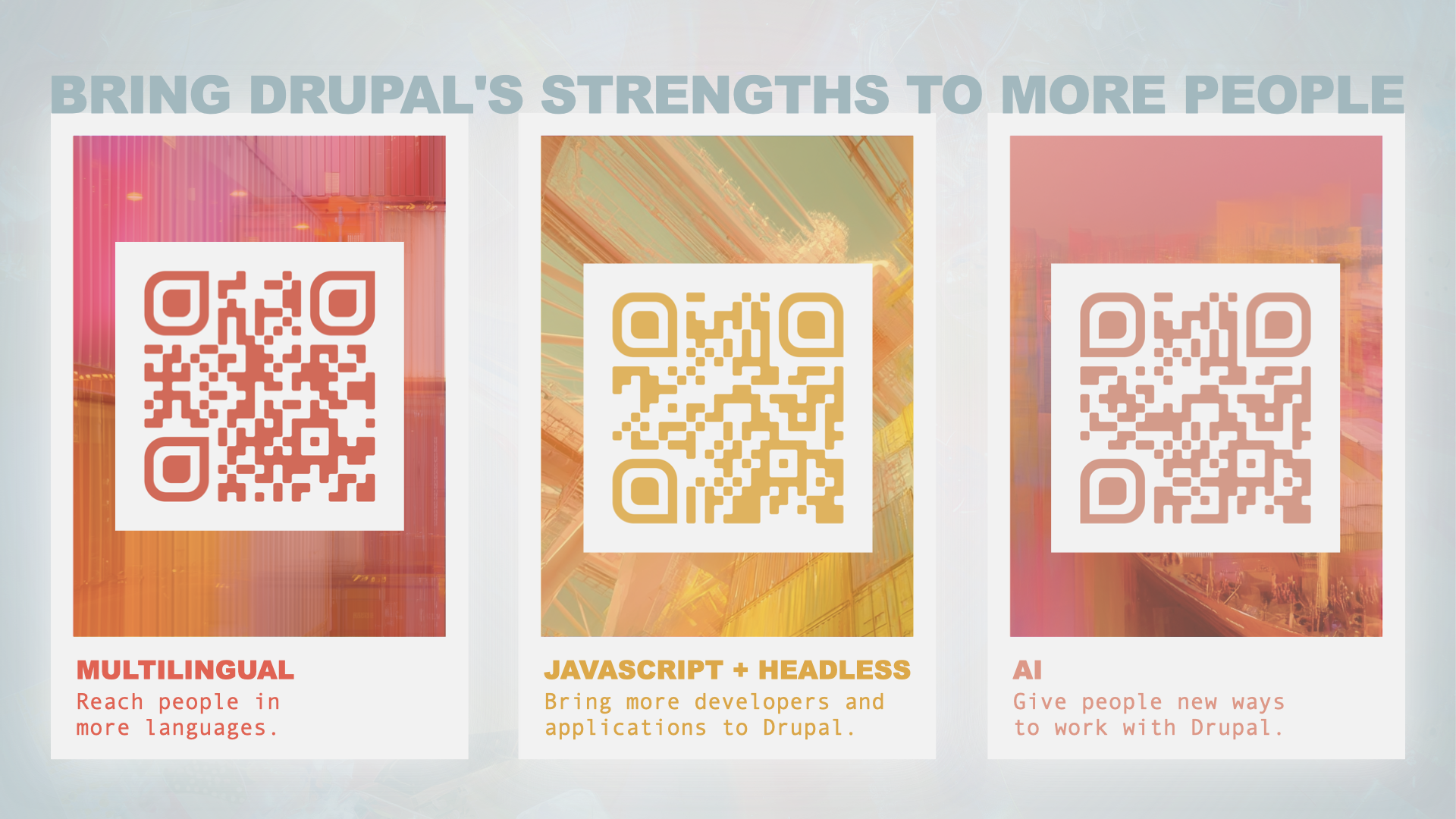
Two years after launching the Starshot initiative, Dries reflected on what it delivered: Drupal CMS, recipes, site templates, Canvas, and a wave of AI tools. Then he showed four ways Drupal is bringing its strengths to more people:
- Multilingual. Building multilingual sites is now dramatically simpler, and Drupal Canvas fully supports multilingual content.
- JavaScript. Canvas code components can be written in React, treating JavaScript developers as first-class citizens.
- Headless. Official headless support now spans five frameworks, including newly added Angular.
- AI. A new public demo site lets anyone explore Drupal's AI capabilities, made possible by the partners of the Drupal AI Initiative.
AI assistants are becoming another interface to Drupal
You can already connect an AI assistant to a Drupal site using a recipe that combines Simple OAuth, MCP Server, and the Tool module. Dries demonstrated it on his own photo album module, built to answer questions like "Do you have that photo of Oma wearing her sunglasses?"
Fully exposing his module's capabilities took around 1,000 lines of code. A research prototype built with Matt Glaman reduced that to roughly 20 PHP attributes. Describe a capability once, and it becomes available everywhere: to AI assistants, to workflow tools like ECA, to JavaScript components, and to humans who never touch AI at all.
The Rosetta Sprint: one description, readable by everyone
To turn the prototype into a shared roadmap, Dries announced the Rosetta Sprint. Like the Rosetta Stone, which carried one decree in three scripts, the goal is for Drupal to describe its capabilities once, in a way that AI agents, other systems, and humans can all read.
The sprint will bring key maintainers together for four days of focused work.

The Drupal Advocacy Program: contribution credit for talking about Drupal
Dries named Drupal's reputation gap as the project's number one challenge. Too many people are judging the Drupal of ten years ago, and AI systems trained on old information repeat that outdated story.
His answer is not hype. "Drupal doesn't need hype. It needs a better public record."
So the Drupal Association is launching the Drupal Advocacy Program, a pilot that awards contribution credit for work that helps people discover and understand Drupal: writing tutorials, recording demos, translating articles, amplifying someone else's talk. Each quarter, a focus theme with a ready-made source kit earns double credits.
Submissions open today at drupal.org/advocacy.
Start now, in Rotterdam
Dries closed with the Rotterdam Pilot: a challenge to everyone at DrupalCon to turn the buzz in the room into buzz outside it. Share a takeaway. Clip a talk. Write about someone else's session and credit them.
"Drupal is now light-years ahead of its reputation," he said. Closing that gap is work we can all do, starting this week.
Slides will be posted at dri.es.